

Tentative
8:00 AM – 4:00 PM MST
Reserve Your Seat
- Virtual instructor Led Training
- Complete Hands-on Labs
- Softcopy of Courseware
- Learning Labs
- Virtual instructor Led Training
- Complete Hands-on Labs
- Softcopy of Courseware
- Learning Labs
- You can use your Purchase Card and checkout
- The GSA Contract Number: 47QTCA20D000D
- Call 800-453-5961 for details
- Customize your class
- Delivery Onsite or Online for your organization
- Choice of Dates when and where you want
- Guidance in choosing and customizing your class
Question About this Course?
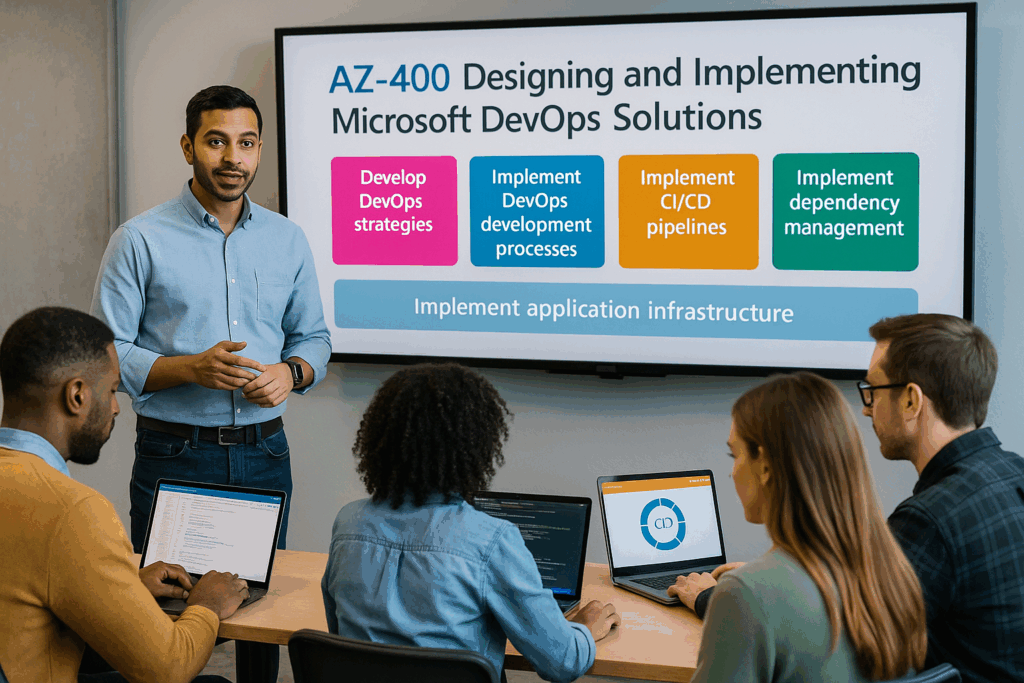
AZ-400T00: Design and Implement Microsoft DevOps Solutions
AZ-400T00: Design and Implement Microsoft DevOps Solutions is an instructor-led course for DevOps engineers, developers, Azure administrators, release engineers, platform engineers, and technical professionals who design and implement DevOps practices using Azure DevOps, GitHub, Azure services, CI/CD pipelines, source control, security, testing, and monitoring.
Students learn how to plan DevOps processes, manage source control, implement build and release pipelines, secure automation, manage dependencies, implement infrastructure as code, deploy applications, and create continuous feedback loops.
Certification: Microsoft Certified: DevOps Engineer Expert
Exam: AZ-400: Designing and Implementing Microsoft DevOps Solutions
Duration: 4 days
Audience: DevOps engineers, Azure administrators, developers, release engineers, platform engineers, site reliability engineers, build engineers, and IT professionals responsible for DevOps solutions.
Why choose Dynamics Edge for AZ-400 training?
Dynamics Edge delivers AZ-400 training with practical DevOps implementation examples, hands-on labs, certification review, and implementation-focused discussion. The course helps students understand how Azure DevOps, GitHub, Azure services, security, testing, and monitoring work together to deliver continuous value.
- Learn how to design and implement DevOps processes, source control, CI/CD pipelines, security, compliance, and monitoring.
- Practice Azure Boards, Azure Repos, GitHub Actions, Azure Pipelines, Azure Artifacts, Azure Key Vault, Bicep, and Azure monitoring scenarios.
- Prepare for AZ-400 certification exam objectives through structured review and lab reinforcement.
- Understand how DevOps improves collaboration, automation, delivery quality, security, and operational feedback.
- Request private team delivery for DevOps adoption, CI/CD modernization, GitHub and Azure DevOps rollout, or cloud engineering team enablement.
What will you learn in AZ-400 training?
Students learn how to design and implement Microsoft DevOps solutions that support continuous integration, continuous delivery, infrastructure automation, security, testing, and feedback.
- Design DevOps processes, collaboration models, work tracking, communication, dashboards, metrics, and traceability.
- Implement source control strategies with GitHub, Azure Repos, branching, pull requests, branch policies, and repository permissions.
- Build CI/CD pipelines using Azure Pipelines, GitHub Actions, YAML, reusable templates, agents, runners, artifacts, and approvals.
- Secure DevOps workflows using Azure Key Vault, service connections, secrets, managed identities, tokens, dependency scanning, and compliance gates.
- Implement infrastructure as code, package management, feature flags, release gates, functional testing, performance testing, and application monitoring.
Course Outline: Microsoft DevOps Solutions AZ-400
Module 1: Implement development for enterprise DevOps
Students learn how DevOps practices improve collaboration, traceability, and flow of work across development, operations, security, and business teams. They review Azure Boards, GitHub Projects, work items, repositories, pull requests, dashboards, metrics, and communication patterns.
Topics include:
- Design DevOps processes and team collaboration.
- Configure Azure Boards and GitHub project tracking.
- Implement work item traceability.
- Configure dashboards, queries, and delivery metrics.
- Integrate communication with Microsoft Teams and project documentation.
Module 2: Implement source control strategy
Students learn how to design source control strategies that support enterprise development. They review Git workflows, Azure Repos, GitHub repositories, branching models, pull requests, branch protection, permissions, tags, large file strategies, and repository optimization.
Topics include:
- Configure Git repositories in Azure Repos and GitHub.
- Design branching and merging strategies.
- Configure pull requests and branch policies.
- Manage repository permissions and tags.
- Optimize repositories for scale and recovery.
Module 3: Implement CI with Azure Pipelines and GitHub Actions
Students learn how to implement continuous integration using Azure Pipelines and GitHub Actions. They review pipeline types, agents, runners, YAML syntax, triggers, variables, templates, build artifacts, test execution, and pipeline troubleshooting.
Topics include:
- Configure Azure Pipelines and GitHub Actions workflows.
- Configure agent pools and pipeline execution.
- Implement CI triggers and YAML pipelines.
- Publish build artifacts and pipeline outputs.
- Integrate automated tests and code coverage.
Module 4: Design and implement a release strategy
Students learn how to design reliable release strategies. They review deployment patterns, release gates, approvals, environments, deployment slots, feature flags, blue-green deployments, canary releases, ring deployments, and rollback approaches.
Topics include:
- Design release strategies and deployment patterns.
- Configure YAML-based release pipelines.
- Configure release gates and approvals.
- Implement feature flags and progressive exposure.
- Plan rollback, hotfix, and resiliency strategies.
Module 5: Implement secure continuous deployment
Students learn how to secure pipelines and deployments. They review Azure Key Vault, secrets management, service connections, managed identities, workload identity federation, access tokens, permissions, security checks, and compliance controls.
Topics include:
- Integrate Azure Key Vault with Azure DevOps.
- Configure secure service connections.
- Manage secrets, keys, certificates, and variables.
- Apply least privilege to pipeline identities.
- Implement security and compliance gates.
Module 6: Manage infrastructure as code
Students learn how infrastructure as code supports repeatable and controlled deployments. They review ARM templates, Bicep, Desired State Configuration, Azure Automation, deployment environments, configuration management, and source-controlled infrastructure.
Topics include:
- Design infrastructure as code strategy.
- Deploy resources using Bicep templates.
- Manage infrastructure through source control.
- Configure deployment validation and testing.
- Review desired state and configuration management options.
Module 7: Design and implement a dependency management strategy
Students learn how to manage packages, artifacts, feeds, dependencies, and versioning. They review Azure Artifacts, GitHub Packages, upstream sources, package feeds, semantic versioning, artifact retention, dependency security, and package governance.
Topics include:
- Configure Azure Artifacts feeds.
- Manage packages and upstream sources.
- Design dependency versioning strategies.
- Manage pipeline artifacts and retention.
- Secure and govern package consumption.
Module 8: Implement continuous feedback
Students learn how continuous feedback improves delivery and operations. They review dashboards, wikis, release notes, application monitoring, performance testing, alerts, instrumentation, telemetry, user feedback, and post-release improvement loops.
Topics include:
- Configure dashboards and team documentation.
- Share knowledge with Azure Project Wiki.
- Monitor application performance.
- Implement Azure Load Testing.
- Use feedback loops for delivery and operations.
Hands-on labs
The AZ-400 labs support hands-on practice for Microsoft DevOps engineers. This single consolidated lab list merges the official MicrosoftLearning AZ-400 hosted labs with the most important lab and exercise topics found in the AZ-400 PowerPoint slides and speaker notes.
- Lab 1: Validate the AZ-400 lab environment.
- Lab 2: Configure Agile planning and portfolio management with Azure Boards.
- Lab 3: Implement work item traceability, dashboards, queries, and project metrics.
- Lab 4: Configure version control with Git in Azure Repos.
- Lab 5: Design and implement branching, pull requests, branch policies, and repository permissions.
- Lab 6: Configure agent pools and compare classic, YAML, Microsoft-hosted, and self-hosted pipeline styles.
- Lab 7: Enable continuous integration with Azure Pipelines.
- Lab 8: Implement GitHub Actions for CI/CD.
- Lab 9: Deploy Docker containers to Azure App Service web apps.
- Lab 10: Configure pipelines as code with YAML.
- Lab 11: Create reusable YAML templates, variables, variable groups, stages, and task groups.
- Lab 12: Control deployments using release gates, approvals, environments, and deployment checks.
- Lab 13: Set up and run functional tests in a pipeline.
- Lab 14: Integrate Azure Key Vault with Azure DevOps.
- Lab 15: Secure service connections, secrets, secure files, tokens, and pipeline identities.
- Lab 16: Enable dynamic configuration and feature flags with Azure App Configuration.
- Lab 17: Deploy infrastructure using Azure Bicep templates.
- Lab 18: Configure package management with Azure Artifacts.
- Lab 19: Monitor application performance with Azure Load Testing, Azure Monitor, Log Analytics, and Application Insights.
- Lab 20: Share team knowledge using Azure Project Wiki, Markdown, Mermaid diagrams, release notes, and project documentation.
Certification alignment
This course supports preparation for Exam AZ-400: Designing and Implementing Microsoft DevOps Solutions. The exam validates the ability to design and implement processes and communications, source control, build and release pipelines, security and compliance, and instrumentation strategies.
AZ-400 skills measured
- Design and implement processes and communications.
- Design and implement a source control strategy.
- Design and implement build and release pipelines.
- Develop a security and compliance plan.
- Implement an instrumentation strategy.
Course review
Students should leave the course able to design and implement DevOps practices that support continuous delivery, secure automation, collaboration, and operational feedback. The course review should reinforce Azure Boards, GitHub Projects, Git, Azure Repos, GitHub Actions, Azure Pipelines, YAML, release gates, testing, Azure Key Vault, feature flags, Bicep, Azure Artifacts, monitoring, load testing, and documentation.
Certification exam review
Exam review should focus on scenario-based DevOps design decisions, implementation dependencies, security, automation, and operational feedback. Priority review areas should include GitHub Flow, Azure Boards, repository permissions, branch policies, pull requests, YAML pipelines, reusable templates, agents and runners, GitHub Actions, Azure Pipelines, test automation, release gates, Azure Key Vault, service connections, managed identities, OIDC, Bicep, Azure Artifacts, dependency management, feature flags, Azure Monitor, Application Insights, dashboards, wikis, and deployment strategies.
Question About this Course?
Need help picking the right course?
Call Now