

9:00 AM – 4:00 PM CST
Reserve Your Seat
- Virtual instructor Led Training
- Complete Hands-on Labs
- Softcopy of Courseware
- Learning Labs
- Virtual instructor Led Training
- Complete Hands-on Labs
- Softcopy of Courseware
- Learning Labs
- You can use your Purchase Card and checkout
- The GSA Contract Number: 47QTCA20D000D
- Call 800-453-5961 for details
- Customize your class
- Delivery Onsite or Online for your organization
- Choice of Dates when and where you want
- Guidance in choosing and customizing your class
Question About this Course?
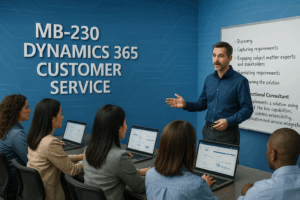
MB-230: Implement Customer Service Solutions using Microsoft Dynamics 365 Customer Service
MB-230T01: Implement customer service solutions using Microsoft Dynamics 365 Customer Service is an instructor-led course for functional consultants who configure and implement Dynamics 365 Customer Service solutions. Students learn how to manage cases, queues, SLAs, knowledge management, workspaces, routing, scheduling, Customer Voice, Contact Center features, and Power Platform extensions.
Certification: Microsoft Certified: Dynamics 365 Customer Service Functional Consultant Associate
Exam: MB-230: Microsoft Dynamics 365 Customer Service Functional Consultant
Why choose Dynamics Edge for MB-230 training?
Dynamics Edge delivers MB-230 training with practical configuration examples, hands-on labs, certification review, and implementation-focused discussion. The course helps students understand how Dynamics 365 Customer Service supports case management, agent productivity, routing, SLAs, knowledge, feedback, and customer engagement.
- Learn how Dynamics 365 Customer Service supports the full case lifecycle.
- Practice configuration tasks used in real Customer Service implementations.
- Prepare for MB-230 certification exam objectives.
- Understand how Customer Service connects with Microsoft Teams, Customer Voice, Contact Center, Copilot, and Power Platform.
- Request private team delivery for customer service transformation, call center modernization, case management rollout, or role-based onboarding.
What will you learn in MB-230T01 training?
Students learn how to configure and implement Microsoft Dynamics 365 Customer Service. The course emphasizes service management processes, case handling, queues, knowledge articles, SLAs, routing, scheduling, agent experience, feedback, and extensibility.
- Configure Customer Service apps, cases, queues, routing rules, and case resolution.
- Create and manage knowledge articles, knowledge search, SLAs, SLA KPIs, and service-level actions.
- Configure Customer Service workspace, agent experience profiles, inbox views, session templates, and productivity tools.
- Configure scheduling, services, resources, work hours, fulfillment preferences, and service activities.
- Extend Customer Service with Customer Voice, Contact Center, Power Platform, Copilot, Teams, and Dataverse configuration.
Dynamics 365 Customer Service MB-230 Course Outline
Learning Path 1: Get started with Dynamics 365 Customer Service
Module 1: Introduce Dynamics 365 Customer Service
Students learn how Dynamics 365 Customer Service supports service teams, agents, supervisors, and administrators. They review the Customer Service landscape, core terminology, user experiences, and related Dynamics 365 applications.
Topics include:
- Describe the Customer Service landscape.
- Identify Customer Service core records and terminology.
- Review Customer Service Hub and Customer Service workspace.
- Explore the Customer Service admin center.
- Understand related apps such as Field Service and Contact Center.
Module 2: Configure foundational Customer Service components
Students learn how foundational Customer Service configuration supports case handling and service operations. They review accounts, contacts, activities, cases, entitlements, queues, and service-level agreements.
Topics include:
- Configure accounts and contacts for service scenarios.
- Understand cases, activities, and customer records.
- Configure queues for workload management.
- Review entitlements and support agreements.
- Configure foundational settings for service operations.
Learning Path 2: Manage cases in Customer Service
Module 3: Manage the case lifecycle
Students learn how to create, manage, resolve, cancel, and reopen customer service cases. They review manual case creation, activity conversion, automatic case creation, case forms, timelines, dashboards, and business process flows.
Topics include:
- Create cases manually.
- Convert activities into cases.
- Configure automatic case creation.
- Resolve, cancel, and reopen cases.
- Use dashboards and business process flows for case management.
Module 4: Configure advanced case management
Students learn how to support complex service scenarios with parent-child cases, case merging, case routing, timelines, and resolution configuration. They review how service teams manage high-volume case processing.
Topics include:
- Configure parent and child cases.
- Merge duplicate cases.
- Configure case resolution behavior.
- Configure timeline controls and case forms.
- Apply routing rules to cases.
Module 5: Use queues to manage case workloads
Students learn how queues help agents and teams manage workload. They configure queues, queue items, queue membership, and routing behavior for customer service operations.
Topics include:
- Create public and private queues.
- Add users and teams to queues.
- Route cases to queues.
- Pick and release queue items.
- Monitor case workload through queues.
Learning Path 3: Manage service-level agreements and knowledge management
Module 6: Configure service-level agreements
Students learn how SLAs help organizations track service commitments. They configure SLA KPIs, SLA items, warning actions, failure actions, success actions, calendars, working hours, and SLA settings.
Topics include:
- Configure SLA KPIs.
- Create SLAs and SLA items.
- Configure warning, success, and failure actions.
- Apply SLAs to cases.
- Configure business closures and working hours.
Module 7: Create and manage knowledge articles
Students learn how knowledge management helps agents resolve cases faster. They create knowledge articles, manage article lifecycle, configure article versions, translations, categories, and publishing processes.
Topics include:
- Create knowledge articles.
- Manage article lifecycle and approval.
- Configure knowledge article versions.
- Configure translations and categories.
- Publish and retire knowledge articles.
Module 8: Configure knowledge search
Students learn how to make knowledge easier to find and use. They configure knowledge article search filters, search settings, article linking, and external knowledge search concepts.
Topics include:
- Configure knowledge search.
- Enable search filters.
- Add custom fields to knowledge search.
- Link knowledge articles to cases.
- Configure internal and external knowledge sources.
Learning Path 4: Configure Customer Service workspace and representative experience
Module 9: Configure Customer Service workspace
Students learn how Customer Service workspace improves agent productivity with multi-session work, productivity pane, presence, search, and case handling tools.
Topics include:
- Describe Customer Service workspace capabilities.
- Use multi-session case handling.
- Configure productivity pane options.
- Review agent scripts and productivity tools.
- Support agent workflows in the workspace.
Module 10: Configure agent experience profiles
Students learn how to tailor the agent experience by configuring profiles, inbox settings, session templates, application tab templates, notification settings, and user assignments.
Topics include:
- Create agent experience profiles.
- Configure profile settings.
- Configure inbox views.
- Configure session and application tab templates.
- Assign profiles to users.
Module 11: Configure productivity tools
Students learn how productivity tools help representatives work faster and more consistently. They review agent scripts, macros, slugs, templates, and guided agent actions.
Topics include:
- Configure agent scripts.
- Create and use macros.
- Configure productivity pane components.
- Use slugs in scripts and macros.
- Support consistent agent workflows.
Learning Path 5: Implement routing and scheduling
Module 12: Configure routing
Students learn how routing sends cases and work items to the right queues, agents, or teams. They compare basic routing and unified routing concepts.
Topics include:
- Compare basic routing and unified routing.
- Configure basic routing rule sets.
- Configure routing rules and rule items.
- Route cases to queues or users.
- Review skills, capacity, and assignment concepts.
Module 13: Configure Customer Service scheduling
Students learn how scheduling supports service activities, resources, business closures, working hours, services, and fulfillment preferences.
Topics include:
- Configure services.
- Configure resources, facilities, and equipment.
- Configure organizational units and business closures.
- Configure working hours.
- Schedule service activities.
Learning Path 6: Implement Dynamics 365 Contact Center
Module 14: Get started with Dynamics 365 Contact Center
Students learn how Dynamics 365 Contact Center supports AI-driven omnichannel customer engagement. They review voice, chat, SMS, channels, users, security roles, and contact center provisioning.
Topics include:
- Describe Dynamics 365 Contact Center.
- Install and provision Contact Center capabilities.
- Configure channels.
- Add users and assign security roles.
- Review Omnichannel and Contact Center personas.
Module 15: Administer Contact Center
Students learn how to administer Contact Center features through the Copilot Service admin center. They review workstreams, capacity profiles, escalation profiles, user settings, queues, and role persona mapping.
Topics include:
- Use Copilot Service admin center.
- Create a contact center and workstreams.
- Configure user settings.
- Configure capacity profiles.
- Configure role persona mapping.
Learning Path 7: Implement Customer Voice
Module 16: Create and send Customer Voice surveys
Students learn how Customer Voice captures feedback from customers. They create survey projects, build surveys, apply themes, configure branching, use variables, and distribute surveys.
Topics include:
- Create Customer Voice survey projects.
- Create surveys and questions.
- Configure survey themes and branching.
- Use survey variables and satisfaction metrics.
- Send surveys by email, link, QR code, or embed.
Module 17: Automate Customer Voice surveys
Students learn how to use Power Automate with Customer Voice to send surveys and connect feedback to service processes.
Topics include:
- Use Power Automate Customer Voice templates.
- Create survey invitations.
- Send surveys through automated flows.
- Connect survey results to cases.
- Review customer feedback in Dataverse.
Learning Path 8: Extend Customer Service by using Microsoft Power Platform
Module 18: Create custom apps for Customer Service
Students learn how Power Platform extends Customer Service when standard features do not meet requirements. They review model-driven apps, canvas apps, Dataverse logic, workflows, Power Automate, and customer self-service portals.
Topics include:
- Create model-driven apps for service scenarios.
- Embed canvas apps in Dynamics 365.
- Use Dataverse logic for validation.
- Create Power Automate cloud flows.
- Review customer self-service portal scenarios.
Module 19: Integrate bots, Copilot, and collaboration features
Students learn how intelligent assistance and collaboration improve the customer service experience. They review Copilot in Service, Microsoft Teams collaboration, Power Virtual Agents, bot handoff, and agent assistance.
Topics include:
- Configure Copilot-assisted case and conversation summaries.
- Configure draft responses and knowledge suggestions.
- Configure Microsoft Teams chat integration.
- Integrate a bot with Omnichannel or Contact Center.
- Transfer bot conversations to human agents.
Hands-on labs
The MB-230 labs support hands-on practice for Microsoft Dynamics 365 Customer Service functional consultants. This single consolidated lab list merges the official GitHub-hosted MB-230 labs with the most important exercise topics found in the MB-230 PowerPoint speaker notes.
- Lab 1: Validate the Dynamics 365 Customer Service lab environment.
- Lab 2: Configure foundational Customer Service settings.
- Lab 3: Create customer service cases.
- Lab 4: Create and manage queues.
- Lab 5: Resolve, cancel, and reopen cases.
- Lab 6: Configure and test case routing.
- Lab 7: Configure automatic record creation and update rules.
- Lab 8: Configure parent-child cases and case merging.
- Lab 9: Configure service-level agreements and SLA KPIs.
- Lab 10: Create and publish knowledge articles.
- Lab 11: Configure knowledge article search and search filters.
- Lab 12: Configure Customer Service workspace.
- Lab 13: Create agent experience profiles.
- Lab 14: Configure inbox views, session templates, and application tab templates.
- Lab 15: Configure Customer Service scheduling.
- Lab 16: Define services, resources, working hours, and service activities.
- Lab 17: Configure Contact Center users, roles, channels, and workstreams.
- Lab 18: Configure capacity profiles, escalation profiles, and role persona mapping.
- Lab 19: Create and send Customer Voice surveys.
- Lab 20: Extend Customer Service with Power Platform, Teams, Copilot, and bot integration.
Certification alignment
This course supports preparation for Exam MB-230: Microsoft Dynamics 365 Customer Service Functional Consultant. The exam validates the ability to implement customer service solutions that support case management, knowledge management, queues, SLAs, routing, representative experience, Customer Voice, Copilot in Service, and Customer Service extensibility.
MB-230 skills measured
- Manage cases in Customer Service.
- Configure representative experience and routing.
- Extend Customer Service.
Course review
Students should leave the course able to configure and support the major areas of Dynamics 365 Customer Service. The course review should reinforce case management, queues, routing, SLAs, knowledge management, workspace configuration, agent experience profiles, Customer Voice, Contact Center administration, Power Platform extensions, and Copilot-assisted service scenarios.
Certification exam review
Exam review should focus on case-based configuration decisions, process dependencies, and troubleshooting. Priority review areas should include case lifecycle, automatic case creation, queues, routing rules, SLAs, SLA KPIs, knowledge articles, knowledge search, Customer Service workspace, agent experience profiles, inbox configuration, session templates, productivity tools, Customer Voice, Dataverse configuration, Teams collaboration, Copilot in Service, and Power Platform extensibility.
Question About this Course?
Need help picking the right course?
Call Now