

Get This Course
$1,795.00
November 18 - 20, 2026
9:00 AM – 4:00 PM CST
January 20 - 22, 2027
9:00 AM – 4:00 PM CST
February 17 - 19, 2027
9:00 AM – 4:00 PM CST
March 17 - 19, 2027
9:00 AM – 4:00 PM CST
April 21 - 23, 2027
9:00 AM – 4:00 PM CST
May 19 - 21, 2027
9:00 AM – 4:00 PM CST
June 23 - 25, 2027
9:00 AM – 4:00 PM CST
July 21 - 23, 2027
9:00 AM – 4:00 PM CST
August 18 - 20, 2027
9:00 AM – 4:00 PM CST
September 22 - 24, 2027
9:00 AM – 4:00 PM CST
October 20 - 22, 2027
9:00 AM – 4:00 PM CST
November 17 - 19, 2027
9:00 AM – 4:00 PM CST
December 22 - 24, 2027
9:00 AM – 4:00 PM CST
Reserve Your Seat
- Virtual instructor Led Training
- Complete Hands-on Labs
- Softcopy of Courseware
- Learning Labs
- Virtual instructor Led Training
- Complete Hands-on Labs
- Softcopy of Courseware
- Learning Labs
- You can use your Purchase Card and checkout
- The GSA Contract Number: 47QTCA20D000D
- Call 800-453-5961 for details
- Customize your class
- Delivery Onsite or Online for your organization
- Choice of Dates when and where you want
- Guidance in choosing and customizing your class
Question About this Course?
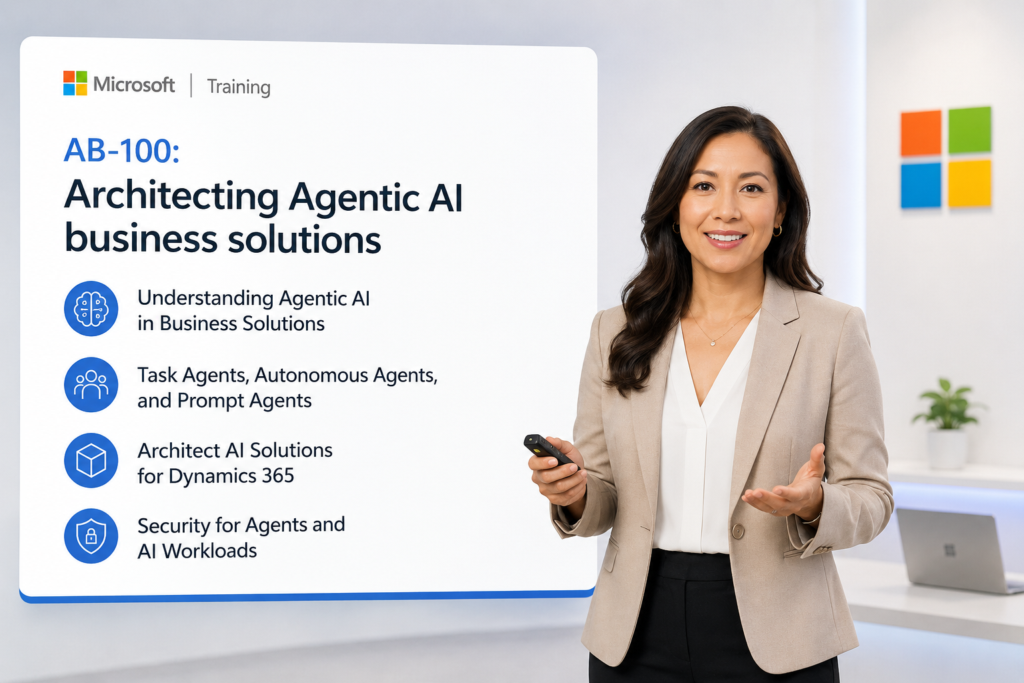
This course is for:
- Solution Architects and Enterprise Architects
- Dynamics 365 architects and senior consultant
- Power Platform solution architects
- Microsoft 365 and Copilot architects
- AI transformation leads
- Technical leads responsible for agentic AI strategy
- Consultants preparing for Microsoft Certified: Agentic AI Business Solutions Architect
Prerequisites
Learners should have experience with:
- Microsoft cloud and business applications
- Dynamics 365, Power Platform, or Microsoft 365 architecture
- Solution design and enterprise integration concepts
- Data, security, governance, and ALM fundamentals
- Basic generative AI and Copilot concepts
Module 1: Introduction to Agentic AI Business Architecture
Topic 1: Understanding Agentic AI in Business Solutions
- Explains how agentic AI differs from traditional automation, chatbots, and workflow tools.
- Introduces agents as goal-oriented systems that can reason, take action, and interact with business data.
- Connects agentic AI to business transformation, productivity, customer experience, and operational redesign.
Topic 2: Microsoft Agentic AI Solution Landscape
- Reviews the roles of Microsoft Copilot, Microsoft 365 Copilot, Copilot Studio, Microsoft Foundry, Dynamics 365, and Power Platform.
- Explains how Microsoft platforms support prebuilt agents, custom agents, AI prompts, business apps, and enterprise data grounding.
- Helps learners understand when to use Microsoft-native agents, custom agents, copilots, or extended business applications.
Topic 3: Architect Responsibilities for AI-First Solutions
- Defines the role of the AI-first solution architect in strategy, design, governance, adoption, and implementation.
- Emphasizes architectural judgment, business value alignment, security, and lifecycle ownership.
- Connects AB-100 responsibilities to enterprise architecture, solution validation, stakeholder alignment, and measurable outcomes.
Module 2: Analyze Business Requirements for AI-Powered Solutions
Topic 1: Identifying Business Processes for AI Transformation
- Teaches learners how to identify processes where agents can automate tasks, improve decisions, or reduce manual effort.
- Covers use cases across sales, service, finance, supply chain, operations, HR, and knowledge work.
- Helps architects distinguish between simple automation, assisted AI, agentic workflows, and autonomous agents.
Topic 2: Assessing Agent Use Cases
- Evaluates where agents can support task automation, analytics, decision-making, and process orchestration.
- Reviews criteria such as business impact, complexity, risk, repeatability, data availability, and user adoption.
- Helps learners prioritize use cases that are realistic, measurable, and aligned to enterprise goals.
Topic 3: Reviewing Data Readiness for Grounding
- Covers data accuracy, relevance, timeliness, cleanliness, and availability.
- Explains why grounding data quality directly affects AI response quality, trust, and usefulness.
- Helps learners evaluate Dataverse, Dynamics 365, SharePoint, Microsoft Graph, Fabric, external systems, and knowledge sources.
Module 3: Design the AI Strategy for Business Solutions
Topic 1: AI Adoption and Cloud Adoption Framework Alignment
- Introduces Microsoft’s AI adoption concepts through the Cloud Adoption Framework for Azure.
- Shows how governance, strategy, readiness, adoption, management, and innovation apply to AI-powered solutions.
- Helps architects align AI projects with business value, risk management, and enterprise operating models.
Topic 2: Designing the Agentic AI Roadmap
- Defines how to create a phased roadmap for agents, copilots, AI prompts, custom models, and business app extensions.
- Helps organizations move from pilot projects to scalable enterprise AI capabilities.
- Connects roadmap planning to business capability maps, process redesign, platform readiness, and adoption maturity.
Topic 3: Establishing an AI Center of Excellence
- Explains the purpose of an AI Center of Excellence for governance, reuse, standards, training, and responsible AI.
- Covers roles such as business sponsor, solution architect, data owner, security lead, governance lead, and adoption lead.
- Helps learners design operating models that support repeatable, safe, and scalable AI delivery.
Module 4: Evaluate Build, Buy, Extend, and ROI Decisions
Topic 1: Build, Buy, or Extend AI Components
- Teaches architects how to decide whether to use prebuilt Microsoft AI capabilities, extend Copilot, build custom agents, or develop custom models.
- Reviews trade-offs involving cost, complexity, time-to-value, control, security, maintainability, and business differentiation.
- Helps learners recommend practical AI solution patterns for enterprise scenarios.
Topic 2: ROI and Total Cost of Ownership
- Covers ROI criteria for AI-powered business solutions, including efficiency gains, revenue impact, service improvement, risk reduction, and user productivity.
- Explains total cost of ownership across licensing, consumption, implementation, governance, maintenance, and support.
- Helps learners build a business case that compares expected value against implementation and operating costs.
Topic 3: Model Routing and Cost Optimization
- Introduces model routing as a strategy for sending requests to the most appropriate model based on task, cost, speed, risk, and quality.
- Explains how model choice can affect solution performance, cost, accuracy, and governance.
- Helps learners design AI solutions that balance enterprise needs with responsible cost management.
Module 5: Design Agents and AI Components for Business Solutions
Topic 1: Designing Task Agents, Autonomous Agents, and Prompt Agents
- Explains the differences between task agents, autonomous agents, and prompt-and-response agents.
- Shows how to match agent type to business scenario, risk level, required oversight, and process complexity.
- Helps learners design agent behavior, escalation paths, human-in-the-loop review, and business controls.
Topic 2: Designing Copilot Studio Topics, Actions, and Fallback
- Covers agent topics, prompt actions, fallback behavior, and conversational design in Copilot Studio.
- Explains how topics and actions support structured business processes and user interactions.
- Helps learners design agents that are useful, predictable, secure, and maintainable.
Topic 3: Designing AI in Power Apps and Business Applications
- Shows how AI components can be embedded into Power Apps canvas apps and model-driven apps.
- Reviews business process design patterns that combine user interfaces, workflows, AI prompts, connectors, and Dataverse.
- Helps learners apply Power Platform Well-Architected principles to intelligent application workloads.
Module 6: Architect AI Solutions for Dynamics 365
Topic 1: AI for Dynamics 365 Customer Experience and Service
- Covers Copilot and agent design for Dynamics 365 Sales, Customer Service, Contact Center, Field Service, and Customer Insights scenarios.
- Explains business terms, connectors, customizations, and service channel integration.
- Helps learners design AI-supported customer engagement, case resolution, sales productivity, and service automation.
Topic 2: AI for Dynamics 365 Finance and Supply Chain
- Reviews AI features and agent scenarios for finance, procurement, supply chain, operations, and in-app assistance.
- Covers how finance and operations agent chats can use additional knowledge sources.
- Helps learners design AI-supported business processes for ERP users, operational decision-making, and guided work.
Topic 3: Cross-App Dynamics 365 AI Solution Design
- Teaches how to design AI solutions that span multiple Dynamics 365 applications.
- Covers end-to-end business processes such as lead-to-cash, case-to-resolution, procure-to-pay, and demand-to-deliver.
- Helps learners design integrated AI experiences across CRM, ERP, Power Platform, Microsoft 365, and external systems.
Module 7: Design AI Extensibility with Microsoft Foundry and Microsoft 365
Topic 1: Microsoft Foundry and Custom Models
- Introduces Microsoft Foundry tools, models, and custom AI solution patterns.
- Covers when custom models should be created, fine-tuned, or avoided.
- Helps architects design AI components that meet specialized business, data, compliance, or performance requirements.
Topic 2: Microsoft 365 Copilot and Agent Extensibility
- Explains how Microsoft 365 Copilot can be extended with agents, connectors, Teams, SharePoint, and Microsoft Graph.
- Covers business scenarios for Microsoft 365 agents across productivity, collaboration, knowledge management, and service delivery.
- Helps learners design AI experiences where employees already work.
Topic 3: Model Context Protocol and Agent Interoperability
- Introduces extensibility patterns using Model Context Protocol and agent interoperability concepts.
- Explains how external tools, data sources, apps, and services can be made available to agents.
- Helps learners evaluate interoperability, security, governance, and maintainability risks.
Module 8: Orchestrate Prebuilt Agents, Copilots, and AI Features
Topic 1: Orchestrating Microsoft 365 Copilot for Sales and Service
- Reviews the configuration and business value of Microsoft 365 Copilot for Sales and Microsoft 365 Copilot for Service.
- Explains how these copilots connect Microsoft 365 productivity experiences with CRM and service workflows.
- Helps learners design adoption and integration strategies for seller and service agent productivity.
Topic 2: Orchestrating Power Platform AI Features
- Covers AI Builder, AI prompts, AI hub, Copilot Studio, connectors, Dataverse, and Power Automate integration.
- Explains how Power Platform AI features can support low-code intelligent applications.
- Helps learners choose the right Power Platform AI feature for business requirements.
Topic 3: Orchestrating Knowledge Sources
- Explains how knowledge sources improve the quality and relevance of agent responses.
- Covers sources such as SharePoint, Dataverse, Dynamics 365 records, external systems, websites, and curated knowledge bases.
- Helps learners design knowledge strategies that support grounding, access control, compliance, and user trust.
Module 9: Test and Validate AI-Powered Business Solutions
Topic 1: Agent Testing Strategy
- Covers test planning, success criteria, validation metrics, and expected behavior for agents.
- Explains how to test conversations, prompts, actions, workflows, fallback, escalation, and exception handling.
- Helps learners define quality gates before agent deployment.
Topic 2: Prompt Validation and Evaluation
- Teaches learners how to validate prompt effectiveness, consistency, accuracy, tone, and business alignment.
- Covers prompt libraries, prompt engineering guidelines, and reusable prompt patterns.
- Helps architects design prompt governance that reduces risk and improves repeatability.
Topic 3: End-to-End AI Test Scenarios
- Covers testing AI solutions across multiple Dynamics 365 apps, Power Platform components, Microsoft 365, and external systems.
- Explains how to validate data flow, security, user experience, model behavior, and process outcomes.
- Helps learners create business process–based test scenarios instead of isolated feature tests.
Module 10: Monitor, Tune, and Optimize Agentic AI Solutions
Topic 1: Monitoring Agent Performance
- Covers tools and processes for monitoring agents, usage, errors, satisfaction, resolution rates, and business outcomes.
- Explains how telemetry supports operational visibility and continuous improvement.
- Helps learners define dashboards and metrics for agent reliability and business value.
Topic 2: Interpreting Telemetry and User Feedback
- Teaches learners how to analyze backlog, usage patterns, user feedback, and agent performance data.
- Explains how feedback loops can improve prompts, knowledge sources, actions, and model behavior.
- Helps architects design lifecycle practices that keep AI solutions aligned with changing business needs.
Topic 3: Tuning AI Models and Agent Behavior
- Covers tuning strategies for prompts, grounding data, model selection, response quality, and agent workflows.
- Explains how AI-based tools can help identify issues and recommend improvements.
- Helps learners optimize agent performance while maintaining governance and responsible AI requirements.
Module 11: Design ALM for AI-Powered Solutions
Topic 1: ALM for Copilot Studio Agents
- Covers ALM for Copilot Studio agents, topics, actions, connectors, environments, and dependencies.
- Explains how agents should move through development, test, staging, and production environments.
- Helps learners design release management processes for low-code and pro-code AI components.
Topic 2: ALM for Microsoft Foundry and Custom Models
- Reviews lifecycle management for Foundry agents, custom models, model versions, data assets, and evaluation results.
- Explains how model changes should be tracked, validated, approved, and deployed.
- Helps learners design AI model governance that supports auditability and operational control.
Topic 3: ALM for Dynamics 365 and Power Platform AI
- Covers ALM for AI features embedded in Dynamics 365, Power Apps, Power Automate, Dataverse, and business applications.
- Explains how solution layering, environment strategy, configuration data, and deployment pipelines affect AI workloads.
- Helps learners design ALM processes that support enterprise reliability and repeatable delivery.
Module 12: Responsible AI, Security, Governance, Risk, and Compliance
Topic 1: Security for Agents and AI Workloads
- Covers identity, access control, least privilege, data permissions, grounding data security, and model access.
- Explains how agents can introduce new risks when they access systems, data, tools, and actions.
- Helps learners design secure architectures that prevent unauthorized access or unintended automation.
Topic 2: Responsible AI and Risk Management
- Reviews Microsoft responsible AI principles and how they apply to business solutions.
- Covers fairness, reliability, safety, privacy, security, inclusiveness, transparency, and accountability.
- Helps learners design governance controls for AI risk, review, approval, monitoring, and escalation.
Topic 3: Compliance, Audit, and Data Residency
- Covers data residency, data movement, audit trails, model tuning controls, and regulatory considerations.
- Explains how architects should validate compliance across data, prompts, models, actions, and integrations.
- Helps learners design AI solutions suitable for enterprise, regulated industry, and public sector environments.
Question About this Course?
Need help picking the right course?
Contact Us
Call Now
Call Now800-453-5961
×