

Tentative
7:00 AM – 3:00 PM PST
Reserve Your Seat
- Virtual instructor Led Training
- Complete Hands-on Labs
- Softcopy of Courseware
- Learning Labs
- Virtual instructor Led Training
- Complete Hands-on Labs
- Softcopy of Courseware
- Learning Labs
- You can use your Purchase Card and checkout
- The GSA Contract Number: 47QTCA20D000D
- Call 800-453-5961 for details
- Customize your class
- Delivery Onsite or Online for your organization
- Choice of Dates when and where you want
- Guidance in choosing and customizing your class
Question About this Course?
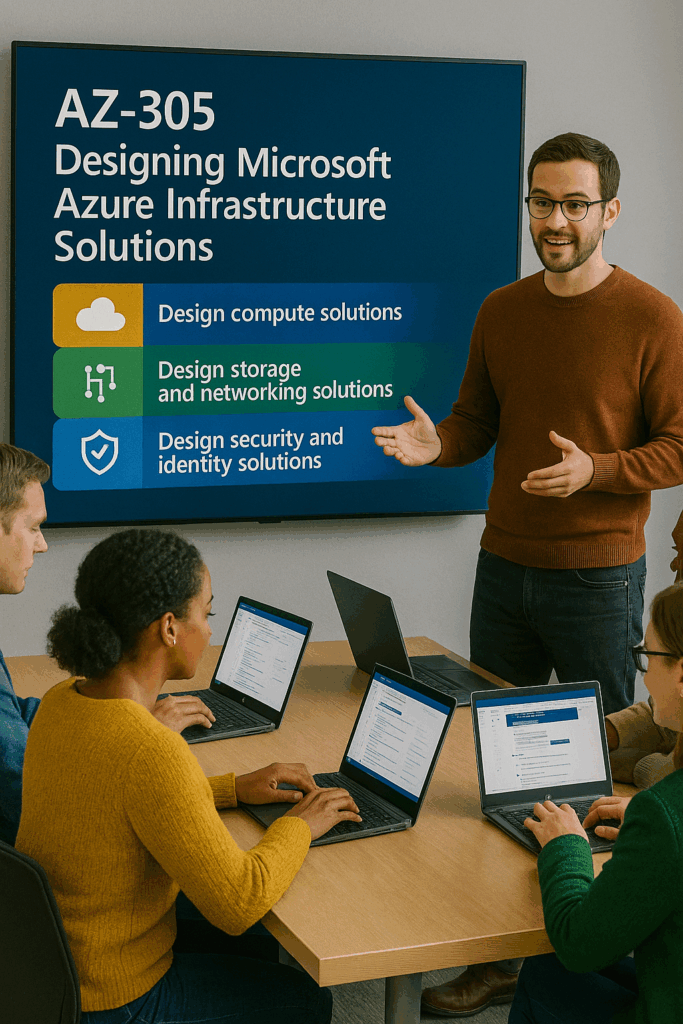
AZ-305T00-A: Design Microsoft Azure Infrastructure Solutions
AZ-305 training
AZ-305T00-A: Design Microsoft Azure Infrastructure Solutions is an instructor-led course for experienced Azure administrators, infrastructure professionals, and cloud architects who design Azure infrastructure solutions for enterprise workloads.
Students learn how to design Azure solutions for identity, governance, monitoring, compute, networking, storage, application architecture, data integration, business continuity, migration, and infrastructure modernization.
Certification: Microsoft Certified: Azure Solutions Architect Expert
Exam: AZ-305: Designing Microsoft Azure Infrastructure Solutions
Duration: 4 days
Audience: Azure administrators, cloud architects, infrastructure architects, solution architects, systems engineers, enterprise architects, and IT professionals who design Azure infrastructure solutions.
Why choose Dynamics Edge for AZ-305T00-A training?
Dynamics Edge delivers AZ-305 training with practical Azure architecture examples, design discussions, certification review, and implementation-focused case studies. The course helps students move beyond administration tasks into solution architecture decisions.
- Learn how to design secure, scalable, resilient, and cost-aware Azure infrastructure solutions.
- Practice architecture decision-making through design case studies and whiteboard discussions.
- Prepare for AZ-305 certification exam objectives through structured course review.
- Understand how Azure identity, governance, networking, compute, storage, monitoring, and business continuity services fit together.
- Request private team delivery for Azure architecture readiness, cloud migration planning, infrastructure modernization, or enterprise cloud design.
What will you learn in AZ-305T00-A training?
Students learn how to evaluate business and technical requirements and translate them into Azure infrastructure designs. The course emphasizes architecture tradeoffs, service selection, resilience, security, governance, monitoring, migration, and operational readiness.
- Design identity, governance, management group, subscription, RBAC, policy, tagging, and monitoring solutions.
- Design compute solutions using virtual machines, App Service, containers, Kubernetes, Azure Functions, and batch processing.
- Design storage solutions for relational, non-relational, semi-structured, unstructured, file, disk, and analytics data.
- Design networking, connectivity, load balancing, application delivery, private access, and network security solutions.
- Design backup, disaster recovery, migration, application architecture, data integration, and operational monitoring solutions.
Microsoft Azure Infrastructure Solutions AZ-305 Course Outline
Module 1: Design governance solutions
Students learn how to design Azure governance structures that support enterprise operations, security, compliance, and cost control. They review management groups, subscriptions, resource groups, Azure Policy, RBAC, resource locks, tagging, and landing zones.
Topics include:
- Design management group and subscription structures.
- Design resource group and tagging strategies.
- Design Azure Policy and compliance solutions.
- Design Azure RBAC and least-privilege access.
- Design Azure landing zone governance.
Module 2: Design compute solutions
Students learn how to select compute services based on application requirements, scalability, availability, operations, and cost. They compare virtual machines, App Service, Azure Functions, Azure Container Instances, Azure Kubernetes Service, and Azure Batch.
Topics include:
- Recommend virtual machine-based compute solutions.
- Recommend App Service solutions.
- Recommend serverless solutions with Azure Functions.
- Recommend container-based solutions.
- Recommend batch processing solutions.
Module 3: Design non-relational storage solutions
Students learn how to design storage for unstructured and semi-structured data. They review Azure Storage accounts, Blob Storage, Azure Files, Azure Disks, Azure NetApp Files, redundancy, performance, access, lifecycle rules, and private endpoints.
Topics include:
- Recommend storage accounts and Blob Storage options.
- Recommend Azure Files and Azure NetApp Files.
- Recommend disk storage solutions.
- Design storage redundancy and durability.
- Design storage access and security.
Module 4: Design relational storage solutions
Students learn how to design relational data solutions that meet availability, scalability, security, and performance requirements. They compare Azure SQL Database, Azure SQL Managed Instance, SQL Server on Azure VMs, Azure Database services, and Cosmos DB design considerations.
Topics include:
- Recommend relational database services.
- Recommend database service tiers and compute tiers.
- Design database scalability and availability.
- Design security for data at rest and in transit.
- Recommend data protection and failover strategies.
Module 5: Design data integration solutions
Students learn how to design data integration and analytics architectures for enterprise workloads. They review Azure Data Factory, Azure Data Lake Storage, Azure Databricks, Azure Synapse Analytics, Microsoft Fabric concepts, and streaming options.
Topics include:
- Design Azure Data Factory integration solutions.
- Design Azure Data Lake solutions.
- Design Azure Databricks analytics solutions.
- Design Azure Synapse Analytics solutions.
- Design streaming solutions with Azure Stream Analytics.
Module 6: Design application architecture solutions
Students learn how to design application architecture solutions that support messaging, events, APIs, caching, configuration, and deployment. They review Service Bus, Event Grid, Event Hubs, API Management, Azure Cache for Redis, App Configuration, and deployment patterns.
Topics include:
- Recommend messaging architecture.
- Recommend event-driven architecture.
- Recommend API integration solutions.
- Recommend caching and configuration solutions.
- Recommend application deployment solutions.
Module 7: Design authentication and authorization solutions
Students learn how to design identity and access solutions for applications and Azure resources. They review Microsoft Entra ID, B2B, external identities, Conditional Access, managed identities, service principals, access reviews, and Azure Key Vault.
Topics include:
- Design Microsoft Entra ID authentication.
- Design B2B and external identity solutions.
- Design Conditional Access and identity protection.
- Design managed identity and service principal access.
- Design secrets management with Azure Key Vault.
Module 8: Design logging and monitoring solutions
Students learn how to design monitoring solutions that provide visibility into Azure infrastructure, applications, and security events. They review Azure Monitor, Log Analytics, Application Insights, workbooks, alerts, diagnostic settings, and log routing.
Topics include:
- Recommend Azure Monitor solutions.
- Recommend Log Analytics workspace designs.
- Recommend Application Insights solutions.
- Design alerting and notification strategies.
- Design log collection and routing.
Module 9: Design network infrastructure solutions
Students learn how to design secure and resilient Azure network architectures. They review virtual networks, subnets, VNet peering, VPN Gateway, ExpressRoute, Virtual WAN, DNS, routing, private endpoints, Azure Firewall, WAF, DDoS Protection, and Bastion.
Topics include:
- Design virtual networks and subnets.
- Design hybrid connectivity with VPN and ExpressRoute.
- Design load balancing and application delivery.
- Design private connectivity and service endpoints.
- Design network security and perimeter protection.
Module 10: Design business continuity solutions
Students learn how to design backup, restore, high availability, and disaster recovery solutions. They review Azure Backup, Recovery Services vaults, storage protection, SQL backup, Azure Site Recovery, replication, failover, RPO, and RTO.
Topics include:
- Design backup and recovery solutions.
- Design Azure VM protection.
- Design Azure SQL backup and restore.
- Design Azure Site Recovery solutions.
- Design RPO and RTO strategies.
Module 11: Design migration solutions
Students learn how to design migration strategies for applications, databases, servers, files, and large data sets. They review Azure Migrate, Database Migration Service, Data Box, Import/Export, AzCopy, Storage Mover, and Cloud Adoption Framework migration planning.
Topics include:
- Design application and server migration strategies.
- Design database migration strategies.
- Design file and storage migration solutions.
- Design large-scale data transfer solutions.
- Use Cloud Adoption Framework migration guidance.
Module 12: Design AI workload infrastructure solutions
Students learn how to apply Azure architecture principles to AI workloads. They review landing zones, secure networking, data foundations, AI PaaS and IaaS workload choices, monitoring, backup, accessibility, and responsible operations.
Topics include:
- Design landing zones for AI workloads.
- Select AI SaaS, PaaS, and IaaS strategies.
- Design secure networking and private access.
- Design data foundations for AI workloads.
- Design backup, monitoring, and operational controls.
Hands-on labs
The AZ-305 labs support design practice for Azure solution architects. This single consolidated lab list is based on the official MicrosoftLearning AZ-305 case studies and the most important lab, case-study, and whiteboard topics found in the AZ-305 PowerPoint speaker notes.
- Lab 1: Design a governance solution.
- Lab 2: Design management groups, subscriptions, resource groups, and tagging.
- Lab 3: Design Azure Policy, RBAC, resource locks, and landing zones.
- Lab 4: Design a compute solution.
- Lab 5: Choose between virtual machines, App Service, Azure Functions, containers, AKS, and Azure Batch.
- Lab 6: Design a non-relational storage solution.
- Lab 7: Design Blob Storage, Azure Files, Azure Disks, Azure NetApp Files, redundancy, lifecycle, and storage security.
- Lab 8: Design a relational storage solution.
- Lab 9: Select Azure SQL Database, SQL Managed Instance, SQL Server on Azure VMs, database tiers, scaling, and failover options.
- Lab 10: Design a data integration solution.
- Lab 11: Design Azure Data Factory, Data Lake, Databricks, Synapse Analytics, Fabric, and Stream Analytics options.
- Lab 12: Design an application architecture solution.
- Lab 13: Design messaging, event-driven architecture, API Management, caching, App Configuration, and deployment patterns.
- Lab 14: Design authentication and authorization solutions.
- Lab 15: Design Microsoft Entra ID, B2B, external identities, Conditional Access, managed identities, service principals, and Key Vault access.
- Lab 16: Design a logging and monitoring solution.
- Lab 17: Design Azure Monitor, Log Analytics, Application Insights, workbooks, alerts, diagnostic settings, and log routing.
- Lab 18: Design a network infrastructure solution.
- Lab 19: Design virtual networks, hybrid connectivity, load balancing, private endpoints, Azure Firewall, WAF, DDoS Protection, and Bastion.
- Lab 20: Design business continuity, migration, and AI workload infrastructure solutions.
Certification alignment
This course supports preparation for Exam AZ-305: Designing Microsoft Azure Infrastructure Solutions. The exam validates the ability to design identity, governance, monitoring, data storage, business continuity, and infrastructure solutions on Microsoft Azure.
AZ-305 skills measured
- Design identity, governance, and monitoring solutions.
- Design data storage solutions.
- Design business continuity solutions.
- Design infrastructure solutions.
Course review
Students should leave the course able to make Azure architecture decisions based on technical requirements, business requirements, security, cost, resiliency, performance, and operational needs. The course review should reinforce governance, identity, compute, storage, networking, app architecture, data integration, monitoring, backup, disaster recovery, migration, and AI workload infrastructure.
Certification exam review
Exam review should focus on scenario-based architecture decisions rather than administration steps. Priority review areas should include management groups, subscriptions, Azure Policy, RBAC, landing zones, Microsoft Entra ID, Conditional Access, Key Vault, compute service selection, storage redundancy, SQL deployment models, Cosmos DB, Data Factory, Databricks, Synapse, Service Bus, Event Grid, API Management, Azure Monitor, Log Analytics, virtual networks, ExpressRoute, VPN, Azure Firewall, WAF, Azure Backup, Azure Site Recovery, Azure Migrate, and Data Box.
Question About this Course?
Need help picking the right course?
Call Now