

9:00 AM – 4:00 PM CST
9:00 AM – 4:00 PM CST
9:00 AM – 4:00 PM CST
9:00 AM – 4:00 PM CST
9:00 AM – 4:00 PM CST
9:00 AM – 4:00 PM CST
9:00 AM – 4:00 PM CST
9:00 AM – 4:00 PM CST
9:00 AM – 4:00 PM CST
9:00 AM – 4:00 PM CST
9:00 AM – 4:00 PM CST
9:00 AM – 4:00 PM CST
9:00 AM – 4:00 PM CST
Reserve Your Seat
- Virtual instructor Led Training
- Complete Hands-on Labs
- Softcopy of Courseware
- Learning Labs
- Virtual instructor Led Training
- Complete Hands-on Labs
- Softcopy of Courseware
- Learning Labs
- You can use your Purchase Card and checkout
- The GSA Contract Number: 47QTCA20D000D
- Call 800-453-5961 for details
- Customize your class
- Delivery Onsite or Online for your organization
- Choice of Dates when and where you want
- Guidance in choosing and customizing your class
Question About this Course?
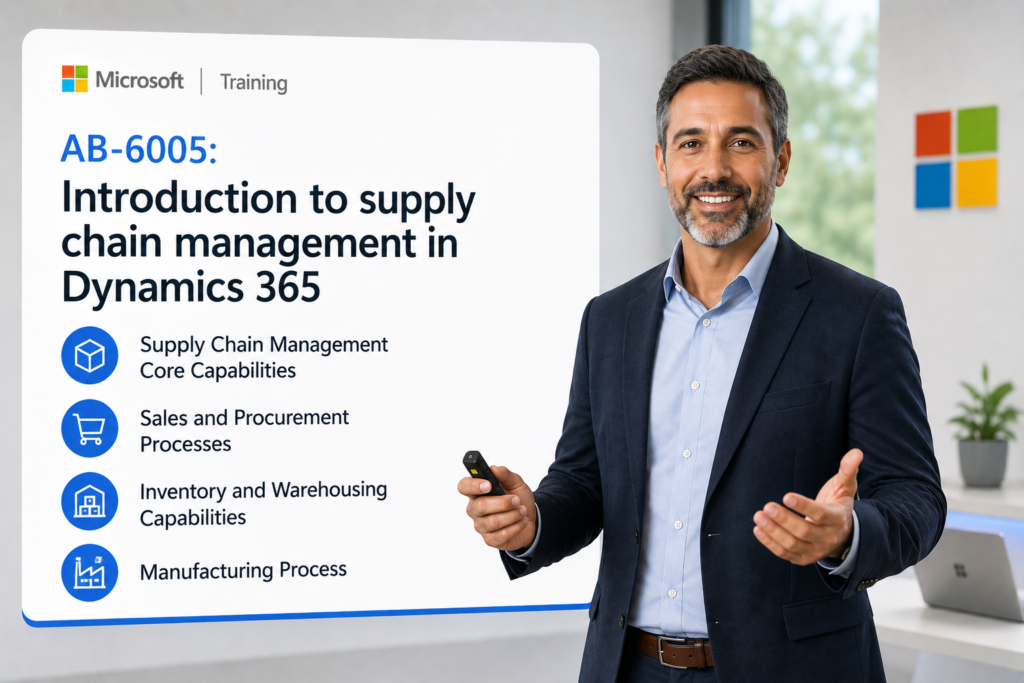
AB-6005: Introduction to Supply Chain Management in Dynamics 365
AB-6005 training
AB-6005: Introduction to Supply Chain Management in Dynamics 365 is a one-day instructor-led course for learners who want to understand how Dynamics 365 Supply Chain Management supports end-to-end business operations.
Students learn how Dynamics 365 Supply Chain Management supports product setup, sales, procurement, inventory, warehousing, quality management, transportation, landed cost, manufacturing, production planning, and AI-assisted supply chain insights.
Course: AB-6005: Introduction to Supply Chain Management in Dynamics 365
Duration: 1 day
Level: Beginner
Product: Dynamics 365 Supply Chain Management
Audience: Business owners, business users, functional consultants, students, operations managers, supply chain users, procurement users, inventory users, warehouse users, manufacturing users, and professionals who want to understand ERP supply chain processes.
Why choose Dynamics Edge for AB-6005 training?
Dynamics Edge delivers AB-6005 training with practical Dynamics 365 Supply Chain Management examples, business process discussion, and hands-on supply chain scenarios. The course helps students understand how Dynamics 365 connects product information, purchasing, sales, inventory, warehousing, manufacturing, and planning into one unified ERP solution.
- Learn how Dynamics 365 Supply Chain Management supports end-to-end operations.
- Understand product setup, product masters, variants, dimensions, pricing, and agreements.
- Explore sales, procurement, inventory, warehousing, quality, transportation, and landed cost.
- Review manufacturing strategies, BOMs, routes, operations, production orders, and master planning.
- Request private team delivery for ERP onboarding, supply chain readiness, operations training, or Dynamics 365 Supply Chain Management adoption.
What will you learn in AB-6005 training?
Students learn how Dynamics 365 Supply Chain Management helps organizations manage operational processes across procurement, sales, inventory, warehousing, manufacturing, and planning.
- Describe core Supply Chain Management capabilities and common business use cases.
- Explain products, released products, product masters, product variants, product dimensions, pricing, discounts, and agreements.
- Describe order-to-cash and procure-to-pay processes.
- Explain inventory, warehouse, costing, quality, transportation, and landed cost capabilities.
- Describe manufacturing strategies, BOMs, routes, operations, production lifecycle stages, shop floor management, master planning, and planning optimization.
Introduction to Supply Chain Management in Dynamics 365 AB-6005 Course Outline
Module 1: Describe Dynamics 365 Supply Chain Management core capabilities
Students learn how Dynamics 365 Supply Chain Management supports business operations and gives organizations insight into products, inventory, procurement, sales, manufacturing, and supply chain performance.
Topics include:
- Describe common use cases for Dynamics 365 Supply Chain Management.
- Describe products and released products.
- Explain product master records, product variants, and product dimensions.
- Describe pricing, discounts, purchase agreements, and sales agreements.
- Describe intercompany supply chain capabilities.
Module 2: Describe the sales and procurement processes in Dynamics 365 Supply Chain Management
Students learn how Dynamics 365 Supply Chain Management supports daily sales and purchasing operations. The module introduces order-to-cash and procure-to-pay business processes.
Topics include:
- Describe the order-to-cash process.
- Describe sales order and sales return creation.
- Describe fulfillment, inventory reservations, picking, and packing.
- Describe the procure-to-pay process.
- Describe purchase requisitions, purchase orders, purchase returns, and purchase receipts.
Module 3: Describe inventory and warehousing capabilities in Dynamics 365 Supply Chain Management
Students learn how Dynamics 365 Supply Chain Management supports inventory control and warehouse operations. The module introduces costing, on-hand inventory, inventory journals, quality management, warehouse management, transportation management, and landed cost.
Topics include:
- Describe inventory costing methods.
- Describe on-hand inventory capabilities.
- Identify common inventory journals.
- Describe quality management and warehouse management capabilities.
- Describe transportation management and landed cost use cases.
Module 4: Describe the manufacturing process in Dynamics 365 Supply Chain Management
Students learn how Dynamics 365 Supply Chain Management supports manufacturing and production planning. The module introduces manufacturing strategies, BOMs, routes, operations, production orders, shop floor management, master planning, and planning optimization.
Topics include:
- Describe lean, discrete, and process manufacturing.
- Describe manufacturing strategies.
- Describe bills of materials, routes, and operations.
- Identify production lifecycle stages and shop floor management capabilities.
- Describe master planning and planning optimization.
Hands-on labs
The AB-6005 labs support hands-on practice for business users and functional consultants who are learning Dynamics 365 Supply Chain Management. This single consolidated lab list is based on the most important Microsoft Learn topics and practical supply chain tasks from the AB-6005 course area.
- Lab 1: Navigate Dynamics 365 Supply Chain Management and identify core workspaces and modules.
- Lab 2: Create and review product records and released products.
- Lab 3: Configure product masters, product variants, and product dimensions.
- Lab 4: Review pricing, discounts, purchase agreements, and sales agreements.
- Lab 5: Create and process a sales order through the order-to-cash lifecycle.
- Lab 6: Create and process a purchase requisition and purchase order through the procure-to-pay lifecycle.
- Lab 7: Review on-hand inventory and post common inventory journal transactions.
- Lab 8: Review warehouse management processes including reservations, picking, packing, and mobile warehouse concepts.
- Lab 9: Review quality management, transportation management, and landed cost scenarios.
- Lab 10: Review manufacturing setup and production flow using BOMs, routes, operations, production orders, shop floor management, and master planning.
Course review
Students should leave the course able to explain how Dynamics 365 Supply Chain Management supports end-to-end operations from product setup through purchasing, sales, inventory, warehousing, manufacturing, and planning. The course review should reinforce products, released products, product masters, variants, dimensions, pricing, discounts, agreements, intercompany, order-to-cash, procure-to-pay, inventory journals, quality management, warehouse management, transportation management, landed cost, manufacturing strategies, BOMs, routes, production lifecycle stages, shop floor management, and planning optimization.
Skills alignment
AB-6005 supports practical readiness for business users, operations teams, supply chain professionals, and functional consultants who need to understand Dynamics 365 Supply Chain Management capabilities. The course helps students understand how supply chain teams use Dynamics 365 to unify operations, improve inventory visibility, manage purchasing and sales processes, support manufacturing, and make better operational decisions.
Question About this Course?
Need help picking the right course?
Call Now