

Get This Course
Reserve Your Seat
- Virtual instructor Led Training
- Complete Hands-on Labs
- Softcopy of Courseware
- Learning Labs
- Virtual instructor Led Training
- Complete Hands-on Labs
- Softcopy of Courseware
- Learning Labs
- You can use your Purchase Card and checkout
- The GSA Contract Number: 47QTCA20D000D
- Call 800-453-5961 for details
- Customize your class
- Delivery Onsite or Online for your organization
- Choice of Dates when and where you want
- Guidance in choosing and customizing your class
Question About this Course?
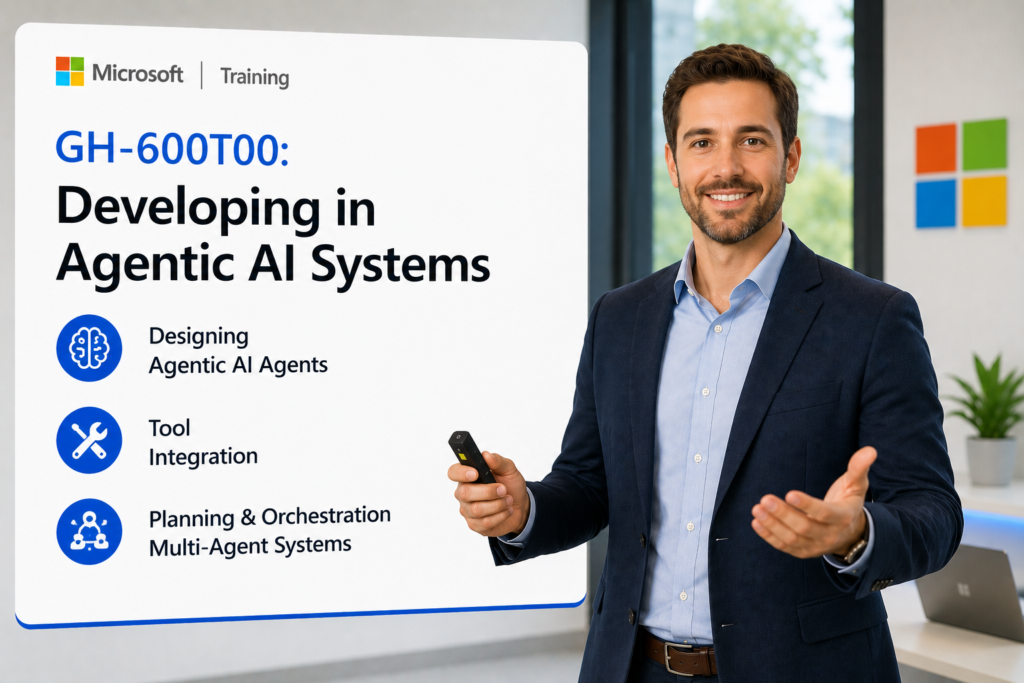
GH-600T00: Developing in Agentic AI Systems
Course Overview
This course teaches developers how to design, build, and deploy agentic AI systems—AI solutions that can plan, reason, and act autonomously using large language models (LLMs), tools, memory, and orchestration frameworks.
Course Outline GH-600T00: Developing in Agentic AI Systems with GitHub CoPilot
Module 1: Introduction to Agentic AI
- What is Agentic AI (vs. traditional AI & copilots)
- Characteristics of AI agents:
- Autonomy
- Planning & reasoning
- Tool usage
- Common architectures (ReAct, Plan-and-Execute, multi-agent systems)
- Use cases:
- Task automation
- Decision support
- Complex workflows
Module 2: Foundations of Large Language Models (LLMs)
- LLM capabilities and limitations
- Prompt engineering fundamentals
- System vs. user prompts
- Token usage and context windows
- Controlling behavior with:
- Temperature, top-p
- Stop sequences
- Responsible AI considerations
Module 3: Designing AI Agents
- Core components of an agent:
- Planning
- Memory
- Tools
- Execution loop
- Agent design patterns:
- Single-agent systems
- Multi-agent collaboration
- Task decomposition strategies
- State management
Module 4: Tool Integration and Function Calling
- Connecting agents to external tools/APIs
- Function/tool calling with LLMs
- Designing tool schemas
- Handling tool responses
- Error handling and retries
- Security considerations when invoking tools
Module 5: Memory and Context Management
- Types of memory:
- Short-term (conversation context)
- Long-term (persistent storage)
- Retrieval-Augmented Generation (RAG)
- Embeddings and vector databases
- Context pruning and summarization
- Personalization using memory
Module 6: Planning and Orchestration
- Planning strategies:
- Chain-of-thought (internal)
- Explicit planning models
- Execution loops and control flow
- Orchestration frameworks:
- Semantic Kernel
- LangChain (conceptual comparison)
- Handling multi-step reasoning tasks
Module 7: Multi-Agent Systems
- When to use multiple agents
- Communication protocols between agents
- Role-based agents:
- Planner
- Executor
- Critic
- Collaboration patterns:
- Sequential
- Parallel
- Hierarchical
- Conflict resolution and coordination
Module 8: Building with Azure AI Services
- Azure OpenAI Service for agentic systems
- Integrating:
- Azure AI Search
- Azure Functions / APIs
- Identity and access management
- Deployment architectures on Azure
Module 9: Evaluation and Debugging
- Evaluating agent behavior:
- Accuracy
- Reliability
- Latency
- Testing strategies:
- Prompt testing
- Scenario-based evaluation
- Observability:
- Logging
- Tracing agent decisions
- Debugging reasoning failures
Module 10: Responsible and Secure Agent Design
- Risks of autonomous agents:
- Hallucination
- Tool misuse
- Data leakage
- Guardrails:
- Content filtering
- Policy enforcement
- Human-in-the-loop design
- Compliance and governance
Module 11: Deployment and Scaling
- Packaging agent applications
- API-based deployment
- Scaling considerations:
- Cost optimization
- Token usage
- Monitoring and maintenance
- CI/CD for AI solutions
Module 12: Capstone Project
- Build an end-to-end agentic system:
- Example projects:
- Autonomous research assistant
- Workflow automation agent
- Multi-agent problem solver
- Example projects:
- Design documentation
- Evaluation and optimization
Skills Gained
- Build autonomous AI agents using LLMs
- Integrate tools and APIs into agent workflows
- Implement memory and retrieval systems
- Design multi-agent architectures
- Deploy scalable agentic applications on Azure
Prerequisites
- Intermediate Python or C# development
- Basic understanding of REST APIs
- Familiarity with AI/ML concepts (helpful but not required)
Question About this Course?
Need help picking the right course?
Contact Us
Call Now
Call Now800-453-5961
×