

9:00 AM – 4:00 PM CST
9:00 AM – 4:00 PM CST
Reserve Your Seat
- Virtual instructor Led Training
- Complete Hands-on Labs
- Softcopy of Courseware
- Learning Labs
- Virtual instructor Led Training
- Complete Hands-on Labs
- Softcopy of Courseware
- Learning Labs
- You can use your Purchase Card and checkout
- The GSA Contract Number: 47QTCA20D000D
- Call 800-453-5961 for details
- Customize your class
- Delivery Onsite or Online for your organization
- Choice of Dates when and where you want
- Guidance in choosing and customizing your class
Question About this Course?
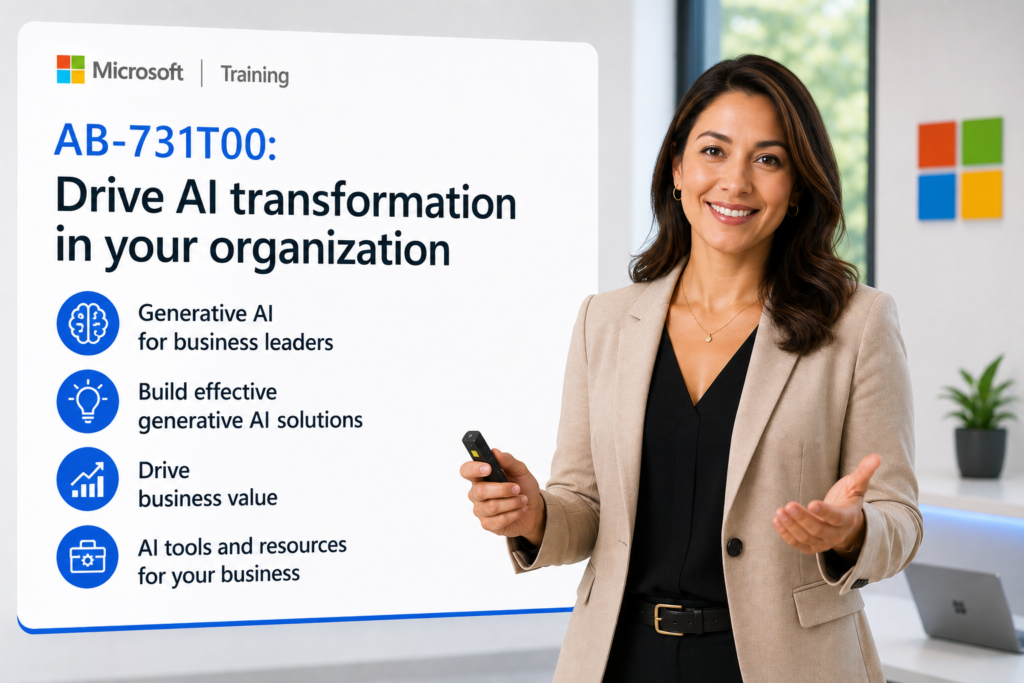
AB-731T00: Drive AI Transformation in Your Organization
AB-731 training
AB-731T00: Drive AI Transformation in Your Organization is a one-day instructor-led course for business leaders who want to guide AI transformation, evaluate AI opportunities, align AI investments to business goals, and lead responsible AI adoption across their teams.
Students learn how generative AI creates business value, how Microsoft Copilot and Microsoft Foundry support enterprise AI scenarios, how to assess AI readiness, how to design responsible AI governance, and how to scale AI adoption across the organization.
Course: AB-731T00: Drive AI Transformation in Your Organization
Certification: Microsoft Certified: AI Transformation Leader
Exam: AB-731: AI Transformation Leader
Why choose Dynamics Edge for AB-731 training?
Dynamics Edge delivers AB-731 training with practical AI transformation examples, Microsoft Copilot and Azure AI scenarios, responsible AI discussion, adoption planning, and business value exercises. The course helps leaders move from AI awareness to AI strategy, adoption, governance, and measurable business outcomes.
- Learn how to identify high-value AI opportunities and connect them to business outcomes.
- Understand how Microsoft 365 Copilot, Copilot Studio, Azure AI, Microsoft Foundry, and AI agents support transformation.
- Practice AI readiness planning across business strategy, technology, data, governance, culture, and adoption.
- Explore responsible AI principles, governance models, security foundations, and adoption risks.
- Request private team delivery for executive AI readiness, Copilot strategy, AI transformation planning, or responsible AI governance.
What will you learn in AB-731 training?
Students learn how to lead AI transformation by evaluating opportunities, selecting Microsoft AI tools, building adoption plans, governing risk, and scaling responsible AI across business functions.
- Explain generative AI, Copilot, agents, Microsoft Foundry, prompt engineering, grounding, RAG, machine learning, and responsible AI.
- Identify business processes where AI can improve productivity, customer engagement, operations, innovation, and decision-making.
- Compare Microsoft AI solution options, including Microsoft 365 Copilot, Copilot Studio, Azure AI services, Microsoft Foundry, Researcher, Analyst, and AI agents.
- Build AI transformation plans using readiness drivers, adoption teams, AI champions, governance councils, and measurable KPIs.
- Apply responsible AI, data security, privacy, governance, cost, licensing, and organizational change management considerations.
Course Outline Drive AI Transformation in Your Organization AB-731
Module 1: Understand the foundations of generative AI for business leaders
Students learn foundational AI concepts and how generative AI differs from traditional AI. The module introduces Microsoft generative AI solutions, agents, business value evaluation, model selection, cost drivers, and common risks.
Topics include:
- Describe AI, generative AI, machine learning, and basic AI concepts.
- Explain Microsoft generative AI solutions such as Copilot, Azure AI, and agents.
- Evaluate business value by identifying problems, outcomes, strategic alignment, and ROI.
- Compare model options, including pretrained and fine-tuned models.
- Identify risks such as hallucinations, bias, reliability issues, data exposure, and unmanaged cost.
Module 2: Build effective generative AI solutions in your organization
Students learn how to improve AI usefulness, accuracy, and trust by applying prompt engineering, grounding, retrieval-augmented generation, data quality, security, and machine learning lifecycle concepts.
Topics include:
- Use prompt engineering to improve AI outputs.
- Ground AI responses using trusted organizational data.
- Explain retrieval-augmented generation and when it applies.
- Build trustworthy AI using data quality, security, governance, and compliance.
- Understand the machine learning lifecycle and business considerations.
Module 3: Drive business value with Microsoft Copilot solutions
Students learn how Microsoft Copilot solutions support productivity, collaboration, and process improvement. The module covers Copilot Chat, Copilot in Microsoft 365 apps, Copilot Studio, Microsoft Graph, extensibility, licensing, and responsible AI in Copilot.
Topics include:
- Explore Microsoft Copilot solutions and experiences.
- Map business processes to Copilot use cases.
- Compare buy, extend, and customize options for Copilot.
- Explain Microsoft Graph and enterprise context.
- Review responsible AI and Copilot licensing considerations.
Module 4: Drive business value with Microsoft Foundry tools
Students learn how Microsoft Foundry and Azure AI services help organizations build AI solutions beyond productivity scenarios. The module introduces language, content, perception, understanding, data, development, search, vision, speech, and document intelligence capabilities.
Topics include:
- Explain why Microsoft Foundry matters for business AI.
- Map business scenarios to Foundry tools and Azure AI services.
- Identify use cases for Azure Vision, Language, Document Intelligence, Search, Speech, and generative AI.
- Compare prebuilt tools, Foundry models, RAG, fine-tuning, and custom AI solutions.
- Evaluate cost, scalability, security, and deployment considerations.
Module 5: Leverage AI tools and resources for your business
Students learn how Microsoft’s AI approach supports enterprise transformation. The module covers Copilot and agents at work, Azure cloud and AI platforms, unified data, modern infrastructure, intelligent apps, and a phased AI adoption foundation.
Topics include:
- Explain the Microsoft AI approach for business transformation.
- Explore how Copilot and agents improve productivity, processes, and functional transformation.
- Use Azure cloud and AI platforms to support secure AI innovation.
- Unify data and modernize infrastructure for AI readiness.
- Apply a phased approach to govern, secure, and manage AI.
Module 6: Create business value with AI
Students learn how to turn AI experiments into measurable business outcomes. The module introduces five AI readiness drivers: business strategy, technology and data strategy, AI strategy and experience, organization and culture, and AI governance.
Topics include:
- Align AI strategy with business priorities.
- Prepare technology and data strategy for scalable AI.
- Define AI strategy, experience, and measurable outcomes.
- Build an AI-ready organization and culture.
- Design AI governance to manage risk and support innovation.
Module 7: Embrace responsible AI principles and practices
Students learn how responsible AI builds trust and helps organizations adopt AI safely. The module covers Microsoft’s responsible AI principles, governance systems, policy models, oversight structures, safeguards, and practical implementation steps.
Topics include:
- Explain why responsible AI matters.
- Apply Microsoft responsible AI principles.
- Design a governance system for AI oversight.
- Create policies, controls, inventories, and compliance processes.
- Use safeguards to address privacy, fairness, reliability, transparency, inclusiveness, security, and accountability.
Module 8: Secure AI for a strong foundation
Students learn how security and governance support safe AI adoption. The module introduces AI security foundations, risk management, procurement and development controls, data protection, access control, automation, training, and collaboration.
Topics include:
- Identify key AI security risks.
- Embed security in AI strategy and procurement.
- Apply controls for data, access, applications, and authentication.
- Use automation for data integrity, policy enforcement, and risk checks.
- Train teams on secure and responsible AI practices.
Module 9: Scale AI in your organization
Students learn how to scale AI adoption across business functions and teams. The module covers executive sponsorship, cross-functional roles, line-of-business leadership, HR, IT, AI champions, business users, subject matter experts, and change management.
Topics include:
- Organize for AI success with clear roles and responsibilities.
- Empower business users with AI tools.
- Empower subject matter experts to apply AI to specialized work.
- Build AI champions and adoption programs.
- Create a repeatable framework for scaling AI across the organization.
Hands-on labs
The AB-731 labs support hands-on practice for business leaders and AI transformation teams. This single consolidated lab list is based on Microsoft Learn course topics and the most important PowerPoint discussion, reflection, and exercise activities.
- Lab 1: Identify high-impact AI opportunities by mapping business problems to productivity, customer engagement, process improvement, and innovation outcomes.
- Lab 2: Evaluate a generative AI use case using business value, feasibility, time to value, risk, cost, and strategic alignment.
- Lab 3: Compare Microsoft AI solution options, including Microsoft 365 Copilot, Copilot Chat, Copilot Studio, Azure AI services, Microsoft Foundry, and agents.
- Lab 4: Build an effective prompt for a leadership scenario and improve the output using role, task, context, source, format, and evaluation criteria.
- Lab 5: Design a grounding approach using trusted business data, RAG concepts, and data quality controls.
- Lab 6: Map common business processes to Copilot, agent, and Foundry scenarios using buy, extend, and build decision paths.
- Lab 7: Create an AI readiness assessment across business strategy, technology and data strategy, AI experience, organization and culture, and governance.
- Lab 8: Define KPIs and value measures for an AI initiative, including productivity, quality, cost, risk, adoption, and customer impact.
- Lab 9: Build a responsible AI governance plan with principles, AI council roles, policy controls, risk reviews, inventories, and compliance checkpoints.
- Lab 10: Create an AI adoption roadmap with executive sponsorship, AI champions, training, communication, phased rollout, security controls, and continuous improvement.
Certification alignment
This course supports preparation for Exam AB-731: AI Transformation Leader and the Microsoft Certified: AI Transformation Leader certification. The exam validates a business leader’s ability to recognize AI transformation opportunities, identify Microsoft AI apps and services, plan adoption, optimize business processes, and guide innovation using Microsoft 365 Copilot, Azure AI, and Microsoft Foundry.
AB-731 skills measured
- Identify the business value of generative AI solutions.
- Identify benefits, capabilities, and opportunities for Microsoft’s AI apps and services.
- Identify an implementation and adoption strategy for Microsoft’s AI apps and services.
Course review
Students should leave the course able to explain generative AI business value and lead AI transformation planning across their organization. The course review should reinforce generative AI concepts, Copilot, Copilot Studio, agents, Microsoft Foundry, Azure AI services, prompt engineering, grounding, RAG, AI readiness, responsible AI, security, governance, licensing, cost, adoption teams, AI champions, KPIs, and change management.
Certification exam review
Exam review should focus on business leadership, strategy, value identification, adoption, and responsible AI rather than technical development. Priority review areas should include generative AI fundamentals, model selection, cost drivers, ROI, hallucinations, bias, prompt engineering, grounding, RAG, data quality, Microsoft 365 Copilot, Copilot Chat, Microsoft Graph, Copilot Studio, Researcher, Analyst, Foundry tools, Azure AI services, build-versus-buy-versus-extend decisions, responsible AI principles, AI council, governance models, adoption teams, champions programs, licensing, privacy, security, cost impacts, and organizational change.
Question About this Course?
Need help picking the right course?
Call Now