

Azure Pipelines now gives teams clearer deployment visibility. YAML pipeline run pages display the artifact associated with each run, while the Stages view shows the latest deployment status for development, testing, staging, and production environments. Large multi-stage pipelines are easier to navigate, and administrators can choose whether paused runs should resume or be canceled when a pipeline is re-enabled.
Service connection management has improved. Administrators can filter connections by type and authentication method, identify connections, and disable obsolete credentials. Microsoft is moving workload identity federation connections from the Azure DevOps issuer to the Microsoft Entra issuer, with affected organizations expected to complete the transition before July 1, 2027.
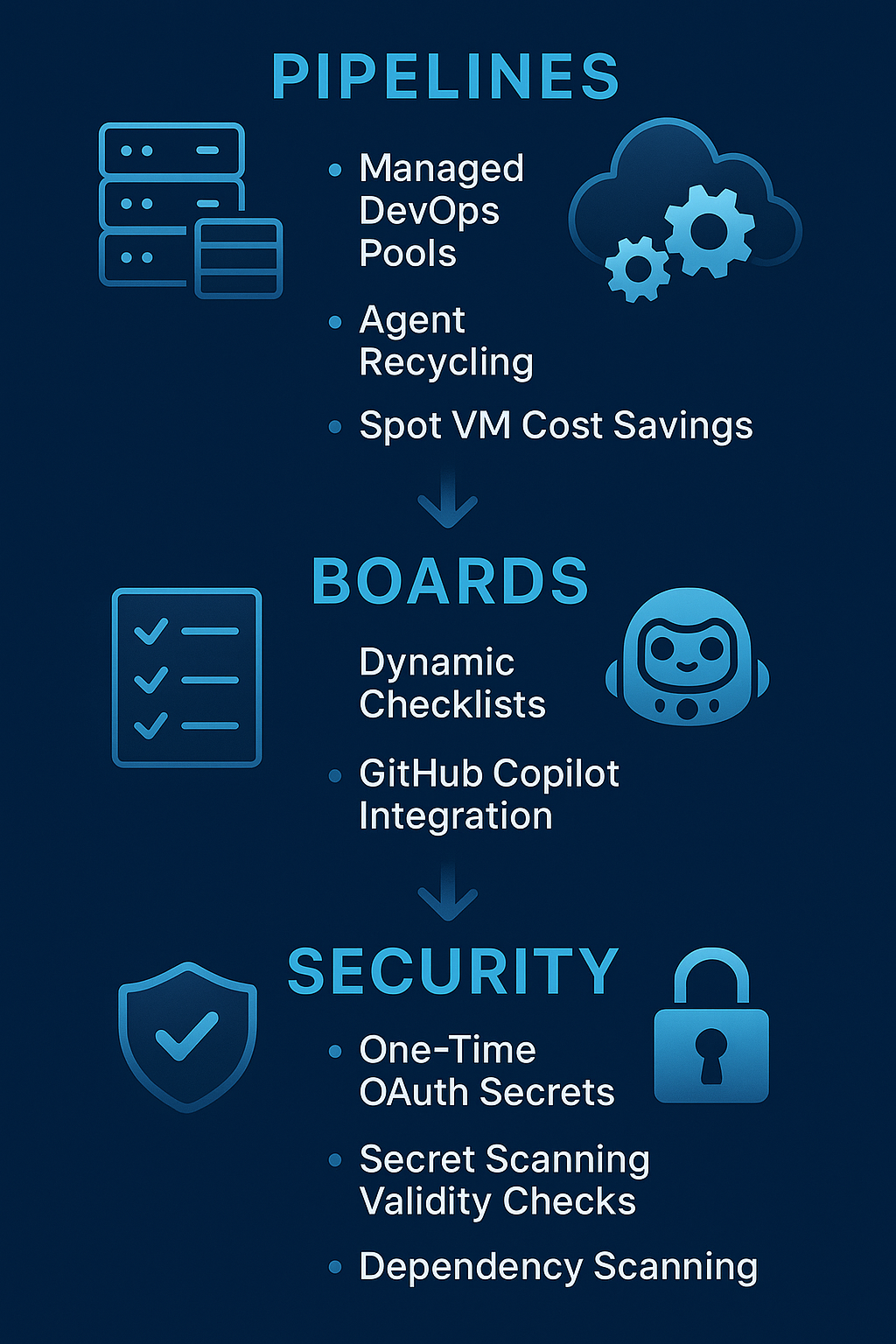
Agent support is expanding. Azure Pipelines introduced Windows ARM64 self-hosted agents and preview support for Apple Silicon macOS agents. Managed DevOps Pools now support Generation 2 virtual machine images. Additional capabilities, including custom startup scripts, agent recycling, and Spot Virtual Machines, are planned for later in 2026.
Azure Boards is becoming more closely connected to AI-assisted development. The GitHub Copilot integration became generally available in January 2026, allowing users to start a Copilot coding-agent task from a work item and create a linked pull request. Teams can select which model Copilot should use. Developers still review, test, and approve generated changes through the pull-request process.
Boards supports more flexible filtering across Kanban boards, sprint boards, backlogs, and custom fields. Markdown work-item fields provide preview and editing modes, condensed cards allow work items to appear on screen, and the Copy Work Item feature offers better control over parent and child links.
Azure Repos is gaining Copilot support. GitHub Copilot code reviews entered public preview for Azure Repos, enabling developers to request AI-assisted analysis of pull requests for bugs, maintainability issues, and code-quality concerns. Other improvements include unresolved-comment indicators, pull-request links after pushing a branch, commit comparisons by SHA, integrated Code Search, and removal of the 100-million Git-object limit.
GitHub Advanced Security for Azure DevOps received major updates. CodeQL default setup became generally available in July 2026, making code scanning easier to enable without maintaining pipeline YAML. Support now includes C and C++, initial scans, and improved scan visibility.
Copilot Autofix entered public preview, allowing Copilot to analyze CodeQL alerts and create pull requests with suggested fixes. Advanced Security status checks can also be enforced as pull-request branch policies, helping organizations block changes that introduce unresolved high- or critical-severity findings.
Security reporting improved through CSV exports, audit events, and automatic hiding of alerts tied to pipeline configurations unused for more than 90 days. Microsoft removed build-identity access to read Advanced Security findings, reinforcing least-privilege practices. Expired personal access tokens can no longer be extended, supporting Microsoft’s shift toward short-lived credentials and Entra-based authentication.
The Azure DevOps Model Context Protocol Server is an important development. The local server became generally available in late 2025, while the hosted Remote MCP Server entered public preview in March 2026. It allows AI clients, including Visual Studio and Visual Studio Code, to interact with Azure DevOps without requiring local MCP installation.
Azure Test Plans now supports Actual Result entries for individual manual test steps. Testers can record outcomes and attachments, improving audit evidence, defect investigation, and communication.
Overall, Azure DevOps in 2026 is becoming more secure, intelligent, and transparent. Microsoft is combining stronger identity controls, easier security scanning, AI-assisted coding and reviews, improved deployment traceability, and better operational reporting to support modern software delivery at scale.
Have a Question ?
Fill out this short form, one of our Experts will contact you soon.
Talk to an Expert Today
Call Now