
Tentative
9:00 AM – 4:30 PM EST
Reserve Your Seat
- Virtual instructor Led Training
- Complete Hands-on Labs
- Softcopy of Courseware
- Learning Labs
- Virtual instructor Led Training
- Complete Hands-on Labs
- Softcopy of Courseware
- Learning Labs
- You can use your Purchase Card and checkout
- The GSA Contract Number: 47QTCA20D000D
- Call 800-453-5961 for details
- Customize your class
- Delivery Onsite or Online for your organization
- Choice of Dates when and where you want
- Guidance in choosing and customizing your class
Question About this Course?
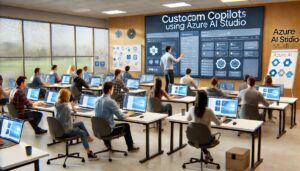
AI-3016: Develop generative AI apps in Azure
Instructor-led Microsoft training for developers, AI engineers, data scientists, and technical professionals who need practical skills building generative AI applications with Microsoft Foundry and Azure AI services. This course uses the Microsoft Learn path Develop generative AI apps in Azure, which is listed as an intermediate learning path with 6 modules for Data Scientist and AI Engineer roles.
Audience: AI developers, Azure developers, data scientists, solution architects, and technical teams building generative AI apps.
Why choose Dynamics Edge for AI-3016 training?
Dynamics Edge turns Microsoft course topics into practical instructor-led training for learners who need job skills, applied-skills preparation, course review, and project-ready capability. The class can be delivered as a public course, private team course, government training, or customized workshop.
- Learn from a Microsoft-focused training provider with practical Azure AI, Power Platform, Dynamics 365, data, security, and enterprise application experience.
- Build job-ready skills for Microsoft Foundry, model deployment, generative AI chat apps, tool use, RAG, optimization, and responsible AI.
- Request private team delivery for AI adoption, application modernization, developer onboarding, government teams, or enterprise AI readiness.
What will you learn in AI-3016 training?
This course helps learners understand how to develop generative AI applications that use language models to interact with users, connect to tools, retrieve enterprise knowledge, improve performance, and apply responsible AI controls. Microsoft describes the learning path as focused on building generative AI apps with Microsoft Foundry and language models.
- Plan and prepare an Azure AI development environment with Microsoft Foundry.
- Select, deploy, test, and evaluate models from the Microsoft Foundry model catalog.
- Build generative AI chat applications using Foundry projects and APIs.
- Extend generative AI apps with tools such as code interpreter, web search, file search, and functions.
- Improve model performance with prompt engineering, RAG, fine-tuning, evaluation, and responsible AI guardrails.
Course Outline AI-3016 Develop generative AI apps in Azure
Module 1: Plan and Prepare to Develop AI Solutions on Azure
Students begin by learning how Microsoft Foundry supports AI application and agent development. They review Foundry resources, Foundry projects, model deployment, development tools, SDKs, and responsible AI principles before creating a practical development environment.
Topics include:
- Microsoft Foundry resources and projects.
- Foundry models, agents, tools, and knowledge.
- Azure AI services and Foundry Tools.
- Visual Studio Code, Microsoft Foundry Toolkit, GitHub Copilot, and SDK options.
- Responsible AI principles for Azure AI development.
Lab 01: Prepare for an AI Development Project
Students create a Microsoft Foundry project, deploy and test a generative AI model, identify project endpoints and keys, and explore the Microsoft Foundry extension for Visual Studio Code.
Module 2: Select, Deploy, and Evaluate Microsoft Foundry Models
Students learn how to choose the right model from the Microsoft Foundry model catalog. They compare models by quality, safety, throughput, cost, deployment type, and evaluation results before deploying models to endpoints.
Topics include:
- Model catalog search, filters, collections, and model providers.
- Model benchmarks for quality, safety, throughput, and cost.
- Deployment options for global, data zone, regional, provisioned, batch, and developer workloads.
- Manual model testing in the playground.
- Automated model evaluation with datasets and standard metrics.
Lab 02: Select, Deploy, and Evaluate Models
Students explore models in the catalog, compare models with the leaderboard, deploy models, test models in the playground, and evaluate model responses with a synthetic dataset.
Module 3: Develop a Generative AI Chat App with Microsoft Foundry
Students learn how to build a chat application that connects to a deployed generative AI model. They compare endpoint options, SDK choices, Chat Completions, Responses API behavior, state management, prompts, and client application patterns.
Topics include:
- Model playground testing and configuration.
- Foundry project endpoint and Azure OpenAI endpoint options.
- Microsoft Foundry SDK and OpenAI SDK usage.
- Chat Completions API versus Responses API.
- System messages, instructions, conversation state, and response handling.
Lab 03: Create a Generative AI Chat App
Students create a Foundry project, deploy a model, retrieve endpoint and key information, and build a client application that chats with the deployed model.
Module 4: Develop Generative AI Apps That Use Tools
Students learn how tools allow generative AI applications to take action, retrieve information, run code, access files, and interact with external systems. They review common tool patterns and how applications handle tool calls.
Topics include:
- Tool use for real-time information, actions, grounding, and workflow automation.
- Code interpreter for running Python in a sandboxed environment.
- Web search for current information.
- File search for grounding responses in uploaded documents.
- Function calling for custom application logic and external system integration.
Lab 04: Create a Generative AI Chat App That Uses Tools
Students experiment with tools in the playground and create an application that uses tools to extend the model beyond basic chat responses.
Module 5: Optimize Generative AI Model Performance with Microsoft Foundry
Students learn how to improve application quality by choosing the right optimization strategy. They compare prompt engineering, Retrieval Augmented Generation, fine-tuning, and combined approaches based on whether the application needs better context, behavior, format, or consistency.
Topics include:
- Context optimization versus model optimization.
- Prompt engineering with system prompts, templates, and examples.
- Retrieval Augmented Generation for domain-specific or current knowledge.
- Fine-tuning for consistent tone, format, and behavior.
- Combining prompt engineering, RAG, and fine-tuning when appropriate.
Lab 05: Optimize a Generative AI Application
Students improve a generative AI application by refining prompts, grounding responses with retrieved data, reviewing when fine-tuning is appropriate, and evaluating the effect of each optimization approach.
Module 6: Implement a Responsible Generative AI Solution in Microsoft Foundry
Students learn how to design and operate generative AI solutions responsibly. They plan for potential harms, apply safety controls, configure guardrails, and use phased delivery to reduce risk before broad deployment.
Topics include:
- Mapping, measuring, mitigating, and managing potential AI harms.
- Responsible AI controls across model, safety system, system message, grounding, and user experience layers.
- Guardrails for violence, hate, sexual content, self-harm, prompt attacks, indirect attacks, and protected material.
- Groundedness, personally identifiable information protection, and content filtering.
- AI impact assessment, operational readiness, and phased release planning.
Lab 06: Apply Content Filters to Prevent Harmful Output
Students use Microsoft Foundry portal to test default guardrails, create a custom guardrail, and apply content filters to an existing deployment.
What hands-on labs and practice activities are included?
Hands-on activities vary by Microsoft delivery environment, but Dynamics Edge uses the official Microsoft course themes to create practical exercises, demonstrations, review tasks, and implementation discussions.
- Guided instructor demonstration based on Microsoft Foundry and Azure AI development topics.
- Practice activity: create a Foundry project, deploy a model, test a chat app, and review endpoint configuration.
- Enhancement lab: add tools, retrieval, custom functions, and responsible AI controls to a generative AI app.
- Enhancement lab: review implementation risks, cost, security, data access, guardrails, and production readiness.
Course Review
By the end of this course, students should be able to plan a Microsoft Foundry project, deploy and evaluate models, build a generative AI chat app, use tools, apply RAG and prompt optimization, and configure responsible AI controls for safer production use.
Question About this Course?
Need help picking the right course?
Call Now