

Microsoft Certified: Azure AI Fundamentals (Exam AI-900) is an entry-level certification that validates your grasp of core AI concepts and Azure services. It covers a broad range of topics – from machine learning basics to cutting-edge generative AI – all within the Azure ecosystem.
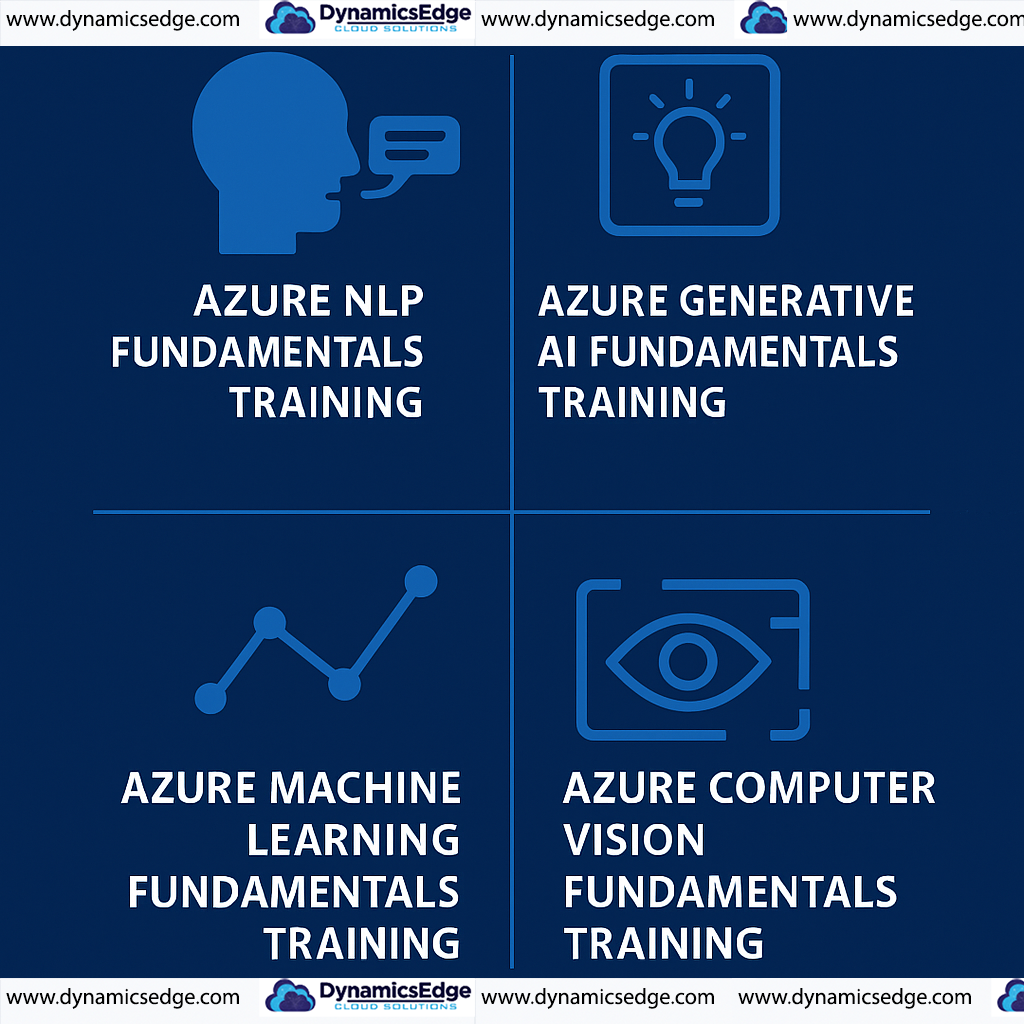
Earning Microsoft AI-900 November 2025 cert demonstrates to employers that you understand the landscape of AI workloads and know which Azure tools can solve which problems. This is particularly valuable for Azure AI-900 fundamentals training November 2025 newcomers aiming for entry-level roles in AI or cloud computing, as it signals a strong foundation in AI technology. Below, we dive into each key pillar of the Microsoft AI-900 training November 2025 curriculum, mapping each area to Azure services and exploring why these skills matter for your career.
Talking the Talk: Azure NLP Fundamentals
Natural Language Processing (NLP) is all about teaching azure ai-900 november 2025 machines to understand and generate human language. In AI-900 Azure AI Fundamentals training November 2025, you learn how NLP workloads handle tasks like key phrase extraction, entity recognition, sentiment analysis, language modeling, speech recognition, and translation. In practice, this means recognizing insights from text (e.g. finding important keywords or determining if a review is positive) and enabling interactions like speech-to-text or real-time language translation. Azure provides powerful azure ai-900 training november 2025 services for these needs, notably Azure AI Language Service (for text analytics, translation, Q&A, etc.) and Azure AI Speech Service (for speech transcription and synthesis). As part of the AI-900 exam, you’ll be expected to identify when to use these services and understand their capabilities in common scenarios (for example, using sentiment analysis to gauge customer feedback).
From a career perspective, mastering Azure NLP fundamentals training november 2025 shows employers you can help build AI solutions like chatbots, virtual assistants, or text analytics pipelines. It maps to roles such as Junior NLP Developer, AI Support Engineer, or Data Analyst (text analytics). These are typically entry-level positions in the US, often commanding salaries on the order of $50,000–$80,000 per year (with variation by location and company). Having the Azure AI Fundamentals certification assures employers that you understand how to leverage cloud AI services for language-centric applications, a skill increasingly in demand as companies integrate features like chatbots and voice assistants into their products.
Imagination in the Cloud: Azure Generative AI Fundamentals
Generative AI is the “creative” side of artificial intelligence – enabling machines to produce content such as text, images, or code. In Azure’s fundamentals, you’ll explore how Azure Generative AI fundamentals training november 2025 models (like GPT or DALL-E) can be used to generate human-like text, create images from prompts, or assist with code, and you’ll learn common use cases (from drafting emails to creating artwork). Crucially, you’ll also cover the responsible AI considerations for generative AI with azure fundamentals training november 2025 recognize the risks of biases or inappropriate content and the need for safeguards.
Azure offers specific services for generative AI, chiefly the Azure OpenAI Service, which gives Azure customers access to OpenAI’s advanced models (such as GPT-4, Codex, and DALL·E). Additionally, Azure has introduced Azure AI Foundry, an all-in-one platform described as “the AI application and agent factory” for building and managing generative AI apps and agents at scale. Through Azure AI Foundry’s model catalog, developers can discover and evaluate a variety of foundation models (from Microsoft, OpenAI, and others) and even fine-tune or orchestrate them for enterprise solutions. The AI-900 exam expects you to know these Azure offerings at a high level – for instance, understanding that Azure OpenAI Service is used for GPT-like capabilities, while AI Foundry provides a unified environment to develop and monitor generative AI solutions.
Why does this matter for your career? Generative AI is a hot area, and even entry-level technologists with knowledge of Azure’s generative AI can add value. You might land roles like AI Developer (Generative AI) or Cloud Technical Consultant assisting companies in implementing GPT-powered features. Employers value the certification’s focus on current AI trends – it shows you’re up-to-date with modern AI capabilities. Entry-level positions involving generative AI expertise can offer competitive salaries – often in the $50,000–$85,000 range in the US for those starting out – and the demand is rapidly growing as businesses seek to incorporate AI content generation and copilots into their workflows.
Training the Machines: Azure Machine Learning Fundamentals
Machine learning (ML) is the engine behind predictive analytics – enabling AI systems to learn from data and make predictions or decisions. Microsoft Azure Machine Learning fundamentals training November 2025 (part of AI-900) introduces you to core ML techniques: you’ll learn the difference between regression (predicting numerical values), classification (categorizing things), and clustering (finding natural groupings) scenarios. You’ll also touch on advanced concepts like deep learning and the Transformer architecture (the technology underpinning modern NLP models). Beyond theory, the curriculum covers essential ML concepts such as features vs. labels in datasets, how training vs. validation data works for building reliable models, and more.
A big focus is on how Azure facilitates the ML lifecycle. The Azure Machine Learning service is Azure’s platform for developing and deploying ML models. In the fundamentals, you learn about capabilities like Automated ML (which can automatically train and tune models for you), Azure’s data and compute services for ML (e.g. using cloud VMs or GPU clusters for training), and how models are managed and deployed in Azure (for example, deploying a trained model as a web service for consumption). While you won’t be writing code in the AI-900 exam, you’ll need to grasp what Azure ML can do – such as simplifying model training or handling the end-to-end workflow of an AI project.
For job seekers, having this ML knowledge on Azure is a strong asset. It shows you can contribute to data science or AI engineering teams by understanding the process to build models and the tools available. Entry-level roles like ML Engineer (Associate), Data Science Assistant, or Azure Cloud AI Intern become attainable. In the US, these positions often start around $45,000–$80,000 annually for candidates with fundamental Azure ML skills. More importantly, the Azure AI Fundamentals cert tells employers you have the mindset to approach problem-solving with data and can quickly get up to speed with Azure’s ML environment – a great foundation for growth into more advanced AI roles.
Seeing is Believing: Azure Computer Vision Fundamentals
Computer vision enables AI to interpret and understand visual content – essentially giving “eyes” to applications. In Azure’s fundamentals training, you learn about common Azure computer vision fundamentals training November 2025 solutions such as image classification (identifying what an image contains), object detection (locating and tagging objects in an image), optical character recognition (OCR) for reading text from images/documents, and even facial detection/analysis (detecting faces and perhaps attributes or emotions). Each of these represents a typical vision workload scenario that an AI solution might handle.
Azure provides ready-made services for vision tasks. The star of the show is Azure AI Vision service, which offers pre-trained models that can analyze images for content, detect objects, read printed or handwritten text, and more. For specialized needs like face recognition, Azure offers the Azure AI Face service, which can detect and analyze faces in images (useful for things like identity verification or sentiment analysis from facial expressions). With AI-900, you aren’t expected to build vision models from scratch, but you should know these services’ capabilities and when to use them – for example, choosing Azure AI Vision to automatically tag a library of photos, or using the OCR capability to digitize scanned forms.
Understanding Azure’s computer vision equips you for roles where image data is key. Think of titles like Computer Vision Technician or Jr. AI Developer (Vision) – you could be helping to implement solutions like smart photo libraries, quality inspection systems using cameras, or ID verification apps. Employers value candidates who know that a task like detecting objects in images can be achieved quickly with Azure’s pre-built AI, rather than reinventing the wheel. As an entry-level professional with this skill set in the US, you might see salary offers in the ballpark of $45,000–$75,000 to start (similar to other AI fundamental roles), with plenty of room to grow as computer vision continues to expand into industries from healthcare to automotive.
AI with a Conscience: Azure Responsible AI Fundamentals
Technical skills alone aren’t enough – modern AI professionals must also understand the ethical and responsible use of AI. Azure’s AI Fundamentals dedicates attention to Responsible AI, to make sureyou grasp the guiding principles that Microsoft (and the industry at large) advocate for any AI solution. These Azure Responsible AI fundamentals training November 2025 principles include fairness, reliability & safety, privacy & security, inclusiveness, transparency, and accountability. In practical terms, you learn to consider questions like: Is an AI system treating different groups of people without bias (fairness)? Is it safe and consistent in its performance (reliability)? Does it protect user data (privacy) and guard against misuse (security)? Is it accessible and not excluding users (inclusiveness)? Are its workings explainable (transparency)? And can we audit and control it, holding it to account for outcomes (accountability)?
While these might sound abstract, Azure provides tools to help implement Responsible AI. For instance, Azure Machine Learning has a Responsible AI dashboard with components for fairness assessment, error analysis, model interpretability, and more, helping developers check their models against these principles. Azure also offers services like Azure AI Content Safety (to detect and filter harmful content) that embody responsible AI in action. In the AI-900 exam, you won’t configure these tools, but you will need to recognize why responsible AI matters and identify considerations or best practices in example scenarios (for example, knowing that an AI that approves loans should be checked for bias to uphold fairness).
Employers increasingly prioritize responsible AI knowledge because it reduces risk and builds trust in AI solutions. By being certified in AI Fundamentals, you signal that you’re not just proficient in tech but also aware of the ethical dimensions of AI – a big plus for any entry-level candidate. This knowledge is applicable across roles (from AI developer to business analyst), as it influences design decisions and compliance. While “Responsible AI Specialist” might not be an entry-level job title, your familiarity with these principles makes you a more attractive hire and could slightly edge up your value. Think of it as part of your overall package – those with a demonstrated commitment to ethical tech may start towards the upper end of junior AI role salary ranges (e.g. closer to $80k if other skills align) due to the extra credibility it provides. More importantly, it sets you on a path to become a well-rounded professional as you advance to roles where you might shape AI policies or governance.
The Right AI for the Job: Azure AI Workloads Fundamentals
Not all AI problems are the same – and a key skill is knowing which type of AI workload fits a given scenario. The Azure AI Fundamentals training begins with this big-picture understanding of AI workloads and considerations. You’ll learn to distinguish scenarios as either needing Azure fundamentals AI training november 2025 computer vision, NLP, or maybe a mix. For example, an app that needs to classify product images is clearly a vision workload, whereas an app that needs to interact via voice involves NLP (speech) workload. There are also document processing workloads – think of extracting information from forms or invoices – which often combine vision (OCR) and language understanding. And of course, the newly emergent generative AI workloads are about creating new content. AI-900 will test your ability to identify these at a high level. If a question describes a scenario about translating customer emails, you should recognize it as an NLP workload (translation task) and know Azure has a service for it; if it’s about indexing a large knowledge base for Q&A, that hints at a search or knowledge mining workload.
Understanding Azure AI workloads fundamentals training November 2025 also means understanding Azure has an array of services to handle them. Under the umbrella of Azure AI Services (formerly Cognitive Services), there’s essentially a tool for every job – Vision, Language, Speech, Search, and so on. For instance, Azure offers Azure Search (now Azure AI Search) for knowledge mining scenarios where you need to ingest, index, and query large information sets. Part of being an Azure AI Fundamentals pro is knowing that if you have unstructured documents and need search functionality, Azure AI Search fundamentals training November 2025 can provide intelligent search with built-in AI capabilities (like OCR and text analysis during indexing). Similarly, if you have conversational needs, Azure Bot Service might come into play (though it’s more in AI-102, it’s touched upon in fundamentals).
Mastering AI workloads and Azure services mapping including Azure Search Fundamentals training November 2025 makes you invaluable in entry-level roles such as Cloud AI Solution Analyst or Technical Consultant (AI). You can walk into a room, hear a business problem, and suggest the right Azure AI service to solve it – a powerful skill for a newcomer. Employers see the AI Fundamentals cert as proof that you won’t use a hammer for every job; you understand the toolbox. This broad knowledge base aligns with various junior roles and thus salary ranges are similar to general Azure AI entry positions (around $50,000–$75,000 to start in the US). The true value, however, is long-term – as you grow, this fundamental understanding helps you architect better solutions or move into cloud architect roles faster.
Searching for Intelligence: Azure Search Fundamentals
In the world of AI, not every answer comes from a prediction or classification – sometimes it’s about finding the right information efficiently. Azure Cognitive Search (recently renamed Azure AI Search) is Azure’s AI-powered search service, and it’s an important part of the AI Fundamentals landscape. While not always highlighted as a standalone domain like vision or NLP, cognitive search embodies what Microsoft calls knowledge mining. It allows you to ingest documents or data, enrich that data with AI (for example, extracting key phrases, detecting entities or OCR on images within files), and then enable sophisticated search queries over it. In AI-900 Azure training November 2025 expect to recognize scenarios where a search solution is appropriate – for instance, building a company-wide document search portal or a Q&A system that retrieves answers from a knowledge base. This falls under the AI workload identification skill: a problem about retrieving info likely maps to a search workload using Azure Search.
Azure Search integrates multiple AI skills under the hood (vision for OCR, language for text analysis, etc.), which makes it a neat example of an AI solution. As part of fundamentals training, you might not delve deeply into configuring Azure Search, but you should know its purpose. When you see terms like “knowledge mining” or “enterprise search with AI,” that’s Azure Search’s domain. And because it’s now part of Azure’s AI services, it can even work with generative models (retrieval-augmented generation, where search provides facts that a model like GPT then uses to formulate answers).
For your career, familiarity with Azure Search widens the scope of problems you can solve as a beginner. Many businesses have tons of data and documents; being the person on the team who knows “we can throw Azure Cognitive Search at this problem” is a big plus. Job roles like Search Engineer (Cloud) or Knowledge Management Analyst can be within reach when you have this knowledge. Even if your title is something general like Cloud Engineer, having search skills means you can tackle projects others might shy from. Entry-level salaries for roles involving Azure Search are in line with other Azure AI roles – roughly $50k–$80k in the US to start – and since effective information retrieval is a critical need, organizations are willing to invest in talent that can deliver it. Azure AI Fundamentals gives you that initial credibility, assuring employers you understand how to leverage cognitive search alongside other AI services.
Next Steps: Azure AI Engineer Associate (AI-102) and Beyond
The Azure AI Fundamentals certification is just the beginning. Many learners use AI-900 as a springboard to more advanced, role-specific certifications. One prominent next step is the Azure AI Engineer Associate certification (Exam AI-102), which is targeted at developers and engineers who build and deploy AI solutions on Azure. While AI-900 is not a formal prerequisite for AI-102, it’s highly recommended as a starting point if you’re new to Azure’s AI ecosystem. Think of AI-900 as learning the map of the AI world, whereas AI-102 is about driving the car.
So what’s different about AI-102? In short, it’s more hands-on and in-depth. As an Azure AI Engineer, you’re expected to design and implement AI solutions using Azure services (from vision and NLP to Azure AI Search and OpenAI). The AI-102 exam covers implementing computer vision and NLP solutions, building chatbots or agents, integrating Azure OpenAI generative models into applications, and even knowledge mining with search. Candidates need to know how to call Azure’s AI services via SDKs or REST APIs and how to integrate these components into end-to-end applications. Coding skills (in Python or C#) and understanding of deployment, security, and performance tuning are part of that certification’s scope.
In contrast, AI-900 remains at the conceptual and awareness level – you won’t be writing code or designing full architectures in the fundamentals exam. It lays the groundwork so that if and when you proceed to AI-102, you already know the services and concepts involved. Many find that starting with AI-900 makes the leap to AI-102 much more manageable, as fundamentals ensure you speak the language of Azure AI. For those charting a career in AI, AI-900 -> AI-102 is a natural progression: fundamentals certify your base knowledge, and the associate-level cert validates your practical ability to build solutions.
In summary, if you’re eyeing roles like Azure AI Engineer, Machine Learning Engineer, or AI Solution Architect down the line, consider Azure AI Fundamentals as your first milestone. It not only boosts your appeal for entry-level jobs right now, but also paves the way for tackling advanced Azure AI certifications with confidence. Employers love to see continuous growth – earning AI-900 shows you have the initiative to learn, and following it up with an associate or specialty cert in AI down the road will further prove your expertise and commitment to the field. Happy learning, and really welcome to you to the exciting world of Azure AI!
Have a Question ?
Fill out this short form, one of our Experts will contact you soon.
Talk to an Expert Today
Call Now