

The Power BI Data Analyst Associate (PL-300) certification and Power BI PL-300 training program is designed to help you gain the skills needed to prepare, model, visualize, and analyze data using Microsoft Power BI training in data analytics with Dynamics Edge Instructor Led Training.
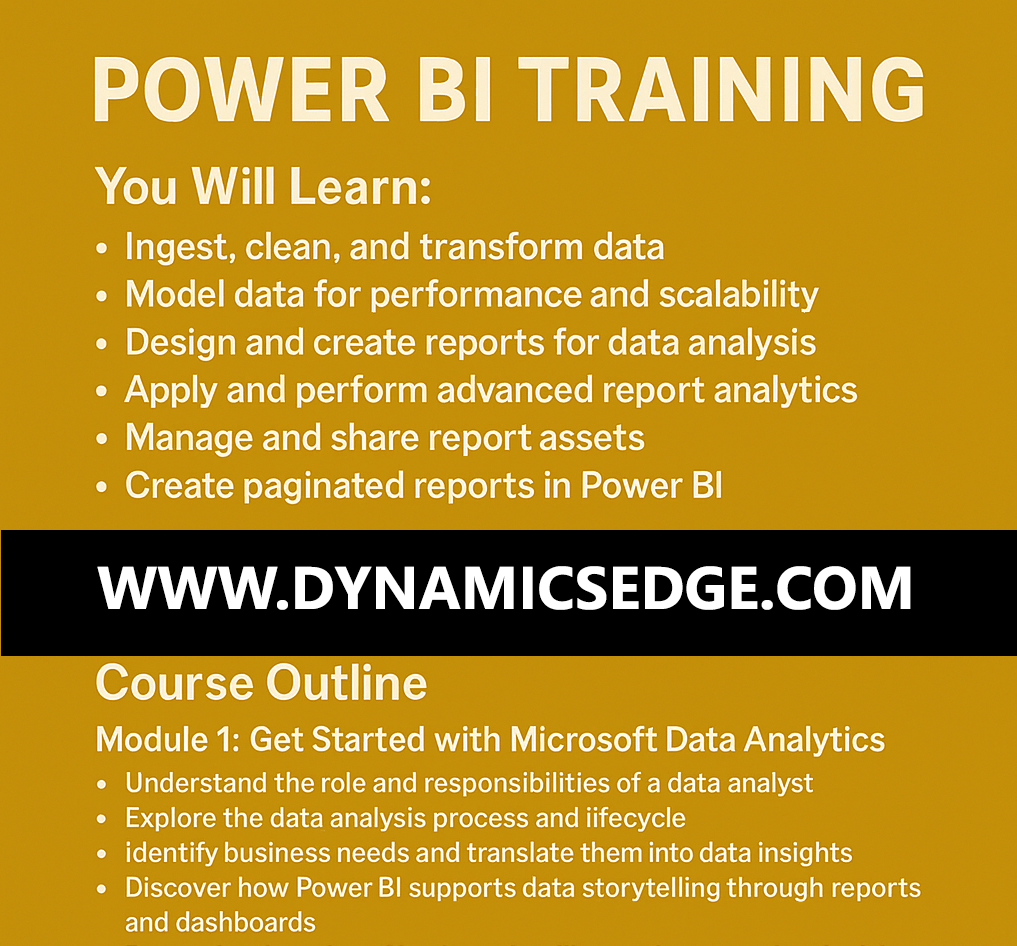
The PL-300: Microsoft Power BI Data Analyst course is designed to equip learners with the end-to-end skills needed to transform raw information into impactful insights using Power BI. Starting from foundational concepts, it introduces the role of a data analyst, the data analysis lifecycle, and the importance of aligning analytics work with business needs. This context helps learners see how their work fits into enterprise decision-making, giving them a more strategic perspective when preparing reports and dashboards.
A major focus of the course is on preparing data for analysis. Learners explore how to connect to diverse data sources, select appropriate storage and connectivity modes, and use Power Query to clean and transform raw inputs into consistent, usable datasets. This stage also emphasizes data profiling to spot quality issues early, helping participants build reliable datasets that form the backbone of effective reporting. By mastering this preparation phase, learners gain confidence in handling messy, real-world data—a skill highly valued by employers.
The training then moves into data modeling, where participants learn to design logical, efficient semantic models and use DAX (Data Analysis Expressions) to create dynamic measures and calculated columns. These modeling skills not only improve the performance of Power BI solutions but also expand analytical possibilities, enabling deeper insights and more interactive reports. Relationships, hierarchies, and time intelligence functions are covered, giving learners the tools to create robust, scalable models that support complex business questions.
In the visualization and reporting phase, the course guides learners through creating intuitive, interactive reports with Power BI Desktop. Participants practice using filters, slicers, drill-throughs, bookmarks, and tooltips to create an engaging experience for report consumers. This section focuses on transforming static numbers into dynamic stories, making insights accessible and actionable for decision-makers. Learners also explore best practices in layout and design, improving the clarity and usability of their reports.
The later part of the PL-300 course emphasizes managing, publishing, and securing Power BI assets in the cloud. Learners become familiar with workspace management, report sharing, scheduling dataset refreshes, and implementing row-level security to control data access. By the end of the course, participants are equipped to manage the full lifecycle of a Power BI project, from data ingestion to secure distribution of insights.
Through its structured modules, the PL-300 course helps learners progress from basic familiarity with Power BI to professional-level competence. They leave with practical, hands-on skills that apply directly to real-world scenarios—whether supporting daily operational decisions, building executive dashboards, or developing analytics for strategic initiatives. By completing the course, learners not only prepare for the PL-300 certification exam but also build the confidence and capability to contribute more effectively to data-driven decision-making within their organizations.
Have a Question ?
Fill out this short form, one of our Experts will contact you soon.
Talk to an Expert Today
Call Now