

Microsoft Entra ID, which was formerly known under Azure Active Directory training, is Microsoft’s modern cloud-based identity and access management (IAM) platform. The Microsoft SC-900 training: Microsoft Security, Compliance, and Identity Fundamentals course is a foundational learning program that introduces the principles of identity, security, and compliance in Microsoft’s cloud ecosystem.
It is the backbone of secure authentication and authorization for Microsoft 365, Azure, Dynamics 365, and thousands of third-party applications. Entra ID centralizes identity services for employees, partners, and customers, offering features like single sign-on (SSO), multifactor authentication (MFA), Conditional Access, and identity governance. In 2025, it has evolved with advanced capabilities such as passkey (FIDO2) enhancements, Agent ID for securing AI-powered agents, expanded role-based access controls, and real-time password spray detection—making it a key enabler of Zero Trust strategies in organizations worldwide.
SC-900 is designed for beginners or professionals looking to strengthen their cloud security awareness, the course prepares learners for the Microsoft Certified: Security, Compliance, and Identity Fundamentals credential—an industry-recognized certification that validates baseline knowledge in modern cloud security and identity management. Passing this certification demonstrates the ability to understand Microsoft Entra ID and related solutions at a strategic and practical level.
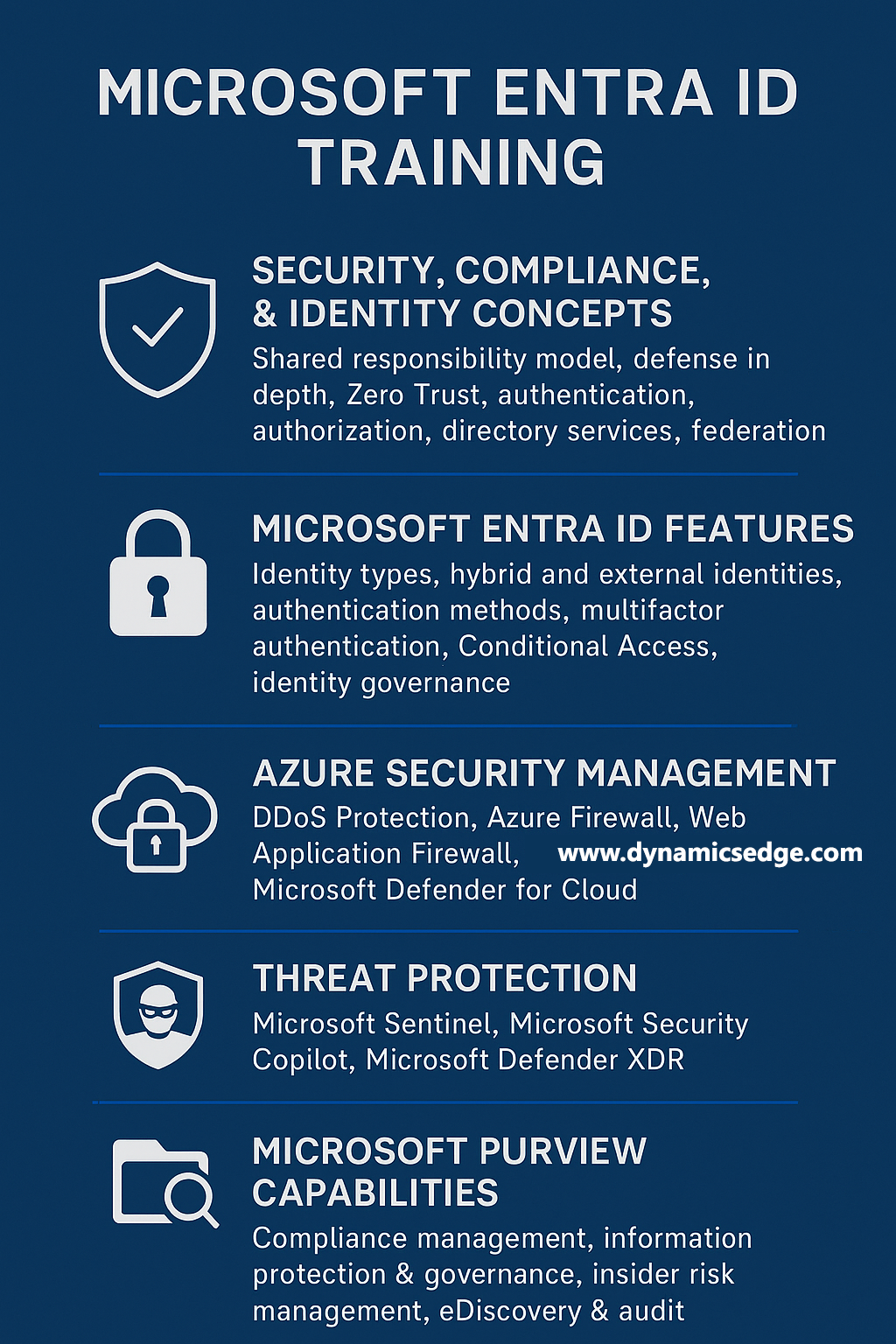
The training starts by covering essential security and compliance concepts, including the shared responsibility model, defense in depth, Zero Trust principles, and governance, risk, and compliance (GRC). It also defines core identity concepts like authentication, authorization, identity as the primary security perimeter, directory services, and federation—ensuring learners understand why identity is central to protecting organizational assets in the cloud.
The Microsoft Cybersecurity training course then focuses on Microsoft Entra ID’s foundational and advanced identity services. It covers types of identities (user, device, service, external, and hybrid), authentication methods, MFA configurations, and self-service password reset. Updated 2025 topics include passkey profiles, Conditional Access “What If” policy simulations, and the shift of risk-based policies into Conditional Access for unified policy enforcement. Learners also explore RBAC, Microsoft Entra ID Governance (access reviews, entitlement management), Privileged Identity Management (PIM), and Entra ID Protection for risk-based sign-in and user monitoring.
A significant portion of the course dives into infrastructure and threat protection. This includes Azure’s built-in security layers such as DDoS Protection, Azure Firewall, Web Application Firewall, Network Security Groups, and Azure Key Vault. Students then progress to Microsoft Defender for Cloud, Cloud Security Posture Management, and DevOps security, followed by Microsoft Sentinel for SIEM capabilities and Microsoft Security Copilot for AI-assisted threat analysis. The Microsoft Defender XDR suite is explored in detail, including protection for email, endpoints, cloud apps, identities, and vulnerability management—reflecting Microsoft’s integrated approach to cyber defense.
Finally, SC-900 addresses compliance, privacy, and data governance through Microsoft Purview training and the Service Trust Portal. This includes compliance score tracking, data classification, sensitivity labels, data loss prevention, retention policies, insider risk management, eDiscovery, and audit capabilities. In 2025, these tools also integrate with enhanced governance features and cross-platform visibility, helping organizations maintain compliance in increasingly complex regulatory environments.
By the end of the SC-900 course, learners will not only understand the breadth of Microsoft’s security, compliance, and identity solutions but also gain updated insights into how Entra ID’s new 2025 capabilities—like passkey authentication, Agent ID, and expanded RBAC—strengthen a Zero Trust architecture. Earning the Microsoft Certified: Security, Compliance, and Identity Fundamentals certification positions professionals to better manage modern identity and security challenges while supporting secure, compliant digital transformation.
Have a Question ?
Fill out this short form, one of our Experts will contact you soon.
Talk to an Expert Today
Call Now