

In September 2025, Microsoft doubled down on its AI-first vision for sales technology with a slate of new Dynamics 365 Sales features and announcements.
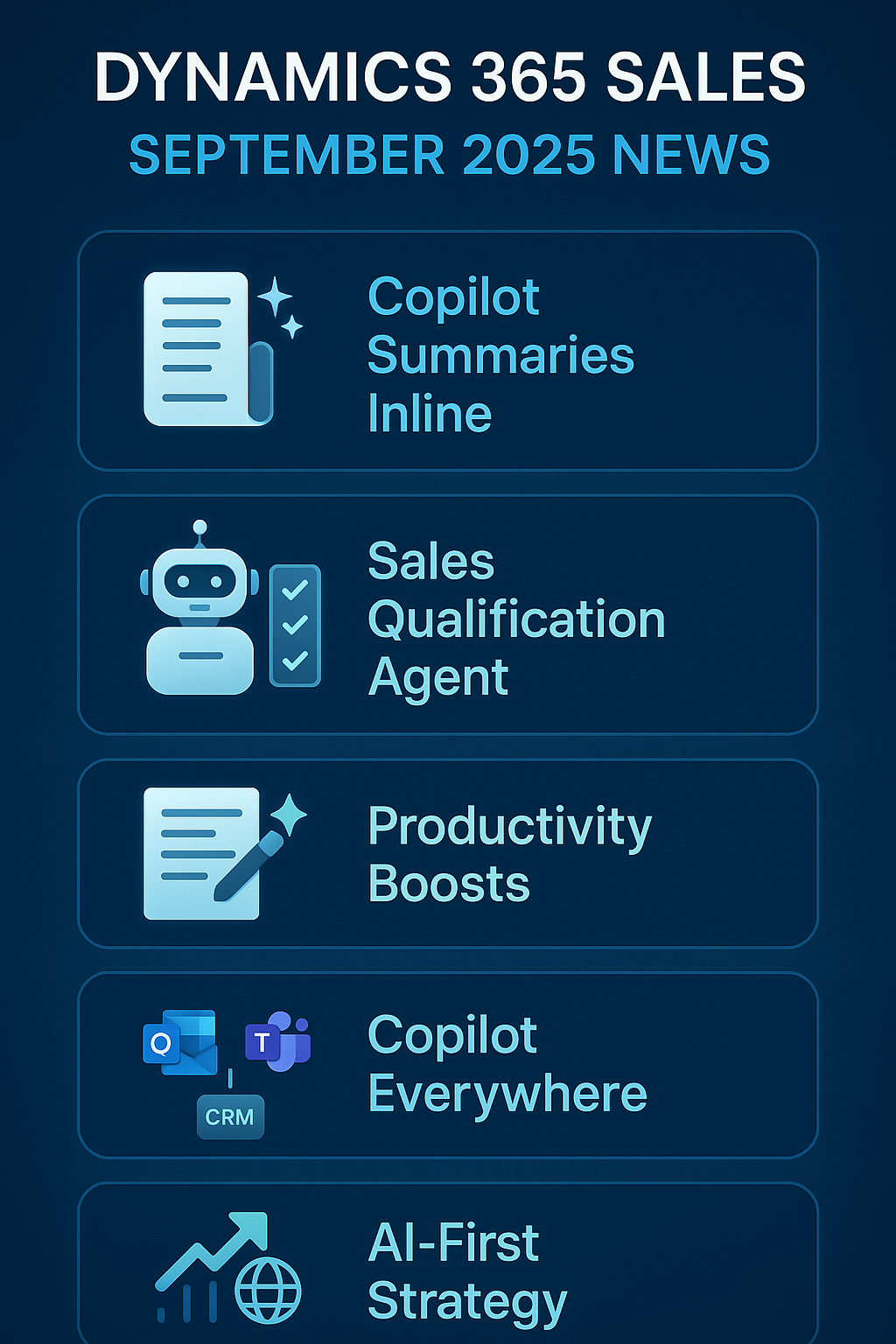
These updates, part of the 2025 Release Wave 2 rolling out in the coming months, illustrate how generative AI is becoming deeply embedded in day-to-day customer relationship management (CRM) workflows. From automatically summarizing records within the sales app to intelligent lead qualification and seamless data entry tools, the latest changes aim to streamline the sales process and boost seller productivity. At the same time, Microsoft is reshaping how these AI capabilities are delivered to organizations—most notably by bundling Dynamics 365 Sales Copilot features into the broader Microsoft 365 Copilot offering. This newsletter-style analysis walks through the key September 2025 updates, explaining how they improve productivity and lead management, and putting them in context of Microsoft’s AI-first strategy and the competitive CRM landscape.
Copilot Summaries Front and Center
One of the most visible enhancements is the new inline AI summary banner for sales records. Dynamics 365 Sales can already generate on-demand summaries of leads, opportunities, and accounts using its Copilot AI assistant—but previously these insights were displayed in a side panel or separate view. Now, by default, an AI-generated summary is shown prominently at the top of each record’s form, giving sellers an immediate, at-a-glance briefing on the customer or deal . Instead of hunting through tabs or opening a Copilot sidebar, a salesperson arriving on a lead or opportunity page can instantly see key details and recent interactions synthesized by AI right within the main workspace. Microsoft made this Copilot in-form banner available in early access over the summer, and it represents a push to make AI guidance more pervasive and harder to miss during the flow of work. By surfacing Copilot’s summary inline, the system effectively provides a real-time “executive summary” for every customer record—helping sellers quickly catch up on context, recall past touchpoints, or identify next steps without manual data digging. This small UX change underscores a larger theme: Microsoft wants AI to be built into the fabric of the CRM experience, not an optional side tool, thereby keeping salespeople focused on customer engagement rather than on navigating information.
Smarter Lead Qualification with AI Agents
Another headline update centers on the Sales Qualification Agent, an AI-powered tool that takes on the heavy lifting of researching and prioritizing inbound leads. Introduced as part of Dynamics 365 Sales Copilot, this intelligent agent scans information from both Dynamics 365 and external online sources to evaluate new leads against an ideal customer profile. It scores each lead’s fit and engagement, recommends which prospects look most promising, and can even draft personalized outreach emails or autonomously move qualified leads into the pipeline. In essence, the AI acts as a tireless virtual sales development rep—sifting through raw inquiries or cold contacts to find the gold nuggets, so human sellers spend time only on the leads most likely to convert.
September’s announcements reveal that Microsoft has further enhanced the Sales Qualification Agent for the upcoming wave. New capabilities include a supervisor dashboard or workspace that allows sales managers to monitor the AI agent’s performance and outcomes. This means sales leaders can track how well the AI is selecting and qualifying leads, see metrics on conversion rates or pipeline contribution, and fine-tune the system as needed. By providing oversight tools, Microsoft is acknowledging that AI agents work best in tandem with human judgment—empowering managers to coach the AI and ensure it’s aligning with business goals. The qualification agent is slated for general availability in October 2025, and it exemplifies the broader trend of AI-driven lead management. For sales teams, this promises less time wasted on low-quality leads and more consistent follow-up on the prospects that truly matter, as the mundane triage and research tasks are offloaded to an algorithm. It’s a concrete way AI is intended to improve seller productivity and pipeline quality simultaneously.
Productivity Boosts: Form Fill Assist and Smart Paste
Sales reps often cite data entry and CRM admin work as major productivity drains. Microsoft is addressing this with new Copilot-powered features that make entering data into CRM faster and easier across all model-driven apps (including Dynamics 365 Sales). One such feature is Copilot Form Fill Assist, which lets users populate a CRM form by simply uploading a document or image containing relevant information. For example, a seller who has a lead’s business card, a PDF form, or an emailed questionnaire can upload that file; Copilot will parse the text and then suggest how to fill in the corresponding fields (name, company, email, address, etc.) right within the form for the user’s review. This works with common file types like text documents, Word files, PDFs, and even images such as JPG or PNG scans of printed text. Instead of typing data line by line, the salesperson gets an AI-generated draft of the record that they can quickly verify and save.
Complementing this is the Smart Paste feature, another time-saver for data entry. Smart Paste allows users to copy a block of text from any source (say, an email signature, a LinkedIn profile, or a spreadsheet) and paste it into an empty CRM form with a single action or hotkey. Copilot will intelligently interpret the pasted text and map each piece to the correct CRM fields, again providing the user with suggested field entries for confirmation. For instance, copying an email that contains a prospective client’s contact info and deal details could instantly populate the lead creation form with the person’s name, title, company, phone number, and notes in the appropriate slots. These AI-assisted form completion capabilities directly target the small but frequent tasks that consume a seller’s time. By reducing manual data transcription, they free up more time for sellers to actually sell—or at least to focus on higher-value activities like building relationships and strategizing on deals. For CRM admins and IT leaders, features like form assist and smart paste also help drive user adoption: if entering data into Dynamics 365 becomes less tedious, salespeople are more likely to keep the system updated, improving overall data quality. Microsoft’s inclusion of these updates in Release Wave 2 underlines the practical side of AI in CRM—it’s not only about flashy analytics or talking robots, but also about streamlining everyday workflows to eliminate friction.
Copilot Everywhere: From Dynamics 365 to Outlook and Teams
Perhaps the most strategic announcement in September 2025 is that Microsoft is folding its Sales Copilot capabilities into the Microsoft 365 Copilot suite. In a Microsoft 365 blog post, the company revealed it is adding “role-based AI solutions” for sales, service, and finance professionals into Microsoft 365 Copilot. In other words, the AI assistance that Dynamics 365 Sales users have been testing—such as meeting summaries, email drafting, and opportunity insights—will become available as an integrated part of the Microsoft 365 Copilot experience that works across Outlook, Teams, and other Microsoft 365 apps. Starting in October 2025, organizations with a Microsoft 365 Copilot subscription can install the Sales Copilot as an add-on (via the new Copilot “agent” store) to empower their sellers within the productivity tools they already use daily. This marks a significant licensing and product delivery shift: instead of treating “Sales Copilot” as a separate Dynamics 365 add-on, Microsoft is bundling it under the umbrella of the Microsoft 365 Copilot platform.
For sales teams and CRM administrators, this move promises a more unified workflow. With the Sales Copilot in Microsoft 365, a seller can accomplish many CRM-related tasks without explicitly opening the Dynamics 365 Sales web application at all. For example, while in Outlook, a salesperson could ask Copilot (via a sidebar or chat interface) to prepare them for an upcoming customer meeting, and the AI will pull in relevant CRM opportunity details, recent email exchanges with that customer, and even news about the customer’s company – all right alongside the email thread. During or after the meeting, the seller might use Copilot in Teams or Outlook to summarize the call and draft a follow-up email, or even to update the CRM record with new information or next steps, using plain English prompts. Microsoft 365 Copilot is designed to connect to “leading CRM tools, including Dynamics 365 and Salesforce, to make it easy to stay informed and engaged” without switching context. That means if a company uses Dynamics 365, the Copilot can read and write to that system; if they use Salesforce instead, Microsoft’s Copilot can still surface Salesforce data in Outlook or Teams for the user. This cross-platform philosophy is noteworthy—Microsoft recognizes that many salespeople live in email and calendars, and that true productivity gains come from bringing AI and data into those hubs of work, rather than forcing constant toggling into the CRM UI.
From a licensing and planning perspective, bundling Sales AI features into Microsoft 365 Copilot could have far-reaching implications. It suggests Microsoft envisions enterprise customers standardizing on Microsoft 365 Copilot as a central AI service that extends into business applications. Companies evaluating these tools will need to consider the cost and value of Microsoft 365 Copilot licenses (which also cover AI in Office apps) versus Dynamics 365-specific licenses or add-ons. The upside is a more seamless user experience: if sellers are already using Microsoft 365 Copilot for general productivity, they get sales-specific intelligence as part of the package, potentially accelerating adoption. The integration also highlights Microsoft’s competitive positioning—leveraging its strength in office productivity software to give Dynamics 365 an edge in AI convenience. By making sales Copilot features available in Outlook and Teams where salespeople spend much of their day, Microsoft is effectively trying to embed CRM into the daily workflow rather than treating it as a separate destination. This could lead to better CRM data hygiene and utilization, since every email or meeting can be triaged with AI and logged without the user leaving their flow of work.
An AI-First Strategy and an Evolving Landscape
Microsoft’s flurry of AI features in Dynamics 365 Sales aligns with a broader AI-first strategy that the company has been evangelizing. Microsoft executives describe “Frontier” organizations that put AI at the heart of their business to reinvent how work is done, and they clearly intend for Copilot to be the engine driving that transformation. By weaving generative AI into CRM, Office, and beyond, Microsoft is aiming to reshape how sales teams operate—making AI a ubiquitous assistant for every salesperson, much like having an analyst and administrator by their side at all times. This vision doesn’t exist in a vacuum; it’s part of an industry-wide race to infuse AI into customer engagement and sales processes. Microsoft’s main rival in enterprise CRM, Salesforce, is likewise heavily invested in AI enhancements, though following a somewhat different path. Salesforce has been expanding its Einstein AI capabilities and recently introduced the “Agentforce” platform, which enables companies to build custom AI agents to automate various tasks across industries. At its Dreamforce 2025 conference, Salesforce highlighted how multiple Fortune 100 companies are evolving into “agentic enterprises” using AI—showcasing use cases where autonomous agents handle everything from data entry to drafting communications. The CRM giant is integrating generative AI across its ecosystem, including embedding it into Slack and industry-specific clouds (for instance, specialized AI agents for healthcare and life sciences) to augment employees’ work.
That said, Microsoft’s approach of tightly coupling sales AI with its productivity suite is a distinctive play. Salesforce’s vision often revolves around its own platform and proprietary AI cloud services, whereas Microsoft is capitalizing on the ubiquity of Windows, Office, and Teams to deliver CRM intelligence in a more holistic, day-to-day context. There are also indications of differing customer strategies: Microsoft’s bundling of Sales Copilot into Microsoft 365 could simplify adoption for customers already in the Microsoft ecosystem, whereas Salesforce’s new AI features may come as add-ons or require using Salesforce’s full stack (and its pricing). Early debates in the industry even touch on effectiveness—Salesforce’s CEO Marc Benioff has boasted of using internal AI agents to reduce support workloads, but skeptics (including some former employees) have questioned whether these AI systems are truly production-ready at scale. In contrast, Microsoft’s gradual rollout of Copilot features in controlled waves might indicate an attempt to get the user experience and integration right (even if some features remain in preview) before wide release.
For mid-market players like HubSpot, the AI revolution is also underway, albeit on a different scale. HubSpot introduced its “Breeze” AI suite, which includes a Breeze Copilot to assist with marketing and sales tasks, as well as AI-driven data enrichment and content generation tools. HubSpot’s AI helps with things like automated lead scoring, email drafting, and even chatbots for customer service, aiming to make advanced capabilities accessible to smaller businesses. Some of these AI features are offered free or at lower cost to encourage adoption. However, HubSpot’s efforts have not grabbed headlines the way Microsoft’s and Salesforce’s have, partly because of scale and focus. The company’s approach is to enhance its all-in-one CRM platform with useful AI tidbits, whereas Microsoft and Salesforce are engaged in a high-stakes race of AI one-upmanship for the enterprise market. Notably, Microsoft’s willingness to integrate its Copilot with other CRMs (like letting a sales team on Salesforce use Microsoft 365 Copilot in Outlook) indicates a pragmatic recognition that hybrid environments exist—and it’s a move that could attract businesses who want AI assistance across all their tools without having to rip and replace systems.
Planning for AI-Powered Selling: Impact on Users and Businesses
The significance of these September 2025 Dynamics 365 Sales updates goes beyond a simple feature list—they signal a new phase of CRM maturity where AI is embedded into core sales processes. Different stakeholders in an organization will feel the impact in various ways. For front-line salespeople, the changes promise a welcome relief from administrative burden and information overload. A seller prepping for a client call no longer needs to manually compile notes from CRM, emails, and LinkedIn; an up-to-date summary is waiting at the top of the opportunity record and can even be delivered in Outlook with a quick Copilot prompt. Routine chores like logging meeting outcomes or updating contact details can be semi-automated through Copilot’s presence in the communication apps they already use. These enhancements are meant to let sellers spend more time engaging customers and strategizing deals rather than doing data entry or hunting for the latest status. Of course, there will be a learning curve—salespeople will need to trust the AI’s suggestions and adapt to working alongside it. Training and change management from sales leadership will be important to encourage adoption (for instance, coaching reps on how to effectively prompt Copilot or how to validate AI-generated content). But given the intuitive nature of these tools (e.g. asking Copilot questions in plain language), the barrier to use is fairly low once the tools are provisioned.
For technical CRM administrators and IT teams, the new wave of AI features requires planning and governance. Admins will need to enable and configure things like the Copilot summary banner and Sales Qualification Agent within Dynamics 365 (ensuring that the underlying data—like lead scoring criteria or AI access to communications—is set up correctly). The supervisor controls for the qualification agent mean admins and managers should define what success looks like (e.g. what lead conversion rate is expected) and monitor the AI’s outputs, fine-tuning any models or business rules as needed. Data quality and security remain paramount: feeding garbage data to an AI will yield poor suggestions, and allowing AI to generate emails or update records means organizations must set guardrails on accuracy and tone. Microsoft has provided some tools for oversight (for example, the Model Context Protocol feature allows connecting external AI models like ChatGPT or Claude to Dynamics 365 with limited, controlled scope of actions, which underscores the need for data protection safeguards when integrating AI). Administrators will also have to coordinate licensing and access—if the company chooses to deploy Microsoft 365 Copilot’s Sales agent, it involves aligning the CRM environment with Azure Active Directory, Exchange, and Teams in new ways. There may be backend work to connect Dynamics 365 and Microsoft 365 Copilot securely, especially if some sales data resides in other systems like Salesforce.
For business decision-makers and sales leadership, the September 2025 updates are a harbinger of how sales organizations might evolve in an AI era. The potential ROI is enticing: higher seller productivity, faster lead response times, and more consistent execution of sales processes. The bundle of Copilot for Sales into Microsoft 365 Copilot could simplify purchase decisions if leadership was already considering enterprise AI tools—now a single investment can empower both individual productivity (Microsoft 365 apps) and CRM intelligence together. However, these leaders will need to consider the broader implications. Budgeting for AI capabilities is one aspect (Microsoft 365 Copilot is a premium add-on in itself), but even more important is shaping strategy around these tools. For instance, sales processes might need to be adjusted to fully leverage AI: if an AI can qualify leads and even send initial outreach emails, what is the new role of a human sales development rep? How should the hand-off between AI-qualified lead and human seller be managed to feel seamless to the customer? Leaders must also tackle the cultural and ethical side—making it clear that AI is there to augment the sales team, not to replace jobs wholesale. In fact, early experiences from peers in the industry show that overhyping AI’s autonomy can backfire if the technology isn’t mature enough. A measured rollout with clear goals (e.g. reduce time spent on logging data by X%, increase lead conversion by Y% through faster follow-up) will help in assessing the true business impact of these features.
Finally, across all user groups, there’s a growing recognition that these AI-infused CRM capabilities are not just experimental or “nice-to-have” – they are quickly becoming standard expectations for modern systems. Microsoft’s September 2025 updates to Dynamics 365 Sales underscore that the future of CRM is deeply intertwined with AI. Competitors are on the same path, and organizations of all sizes will likely feel pressure to adopt similar tools to stay competitive. For those invested in the Microsoft stack, the tight integration of Sales Copilot with everyday apps could be a strong advantage, potentially driving higher adoption rates than past CRM add-ons. As the dust settles on this wave of announcements, one thing is clear: sales teams now have unprecedented AI power at their fingertips. The companies that succeed will be those that plan carefully—upskilling their people, updating their processes, and aligning their technology roadmaps—to harness that power for meaningful productivity gains and better customer outcomes. The AI-powered sales era imagined for years is arriving, and the developments of September 2025 show Microsoft’s determination to lead that charge in both technology and go-to-market approach. For businesses and CRM users, it’s an exciting and critical time to reimagine how sales work gets done, with AI as an ever-present ally in the quest for growth.
Have a Question ?
Fill out this short form, one of our Experts will contact you soon.
Talk to an Expert Today
Call Now