

Azure NLP Training August 2025 is available with Dynamics Edge through Microsoft Azure AI-3003 Training as Microsoft’s Applied Skills learning path and assessment for “Build a natural language processing solution with Azure AI Language.” It’s a hands-on, lab-based credential that validates you can design and implement an NLP solution on Azure—specifically by using the Azure AI Language service and related tooling. Passing the interactive assessment on Microsoft Learn earns you the Applied Skills credential for this scenario.
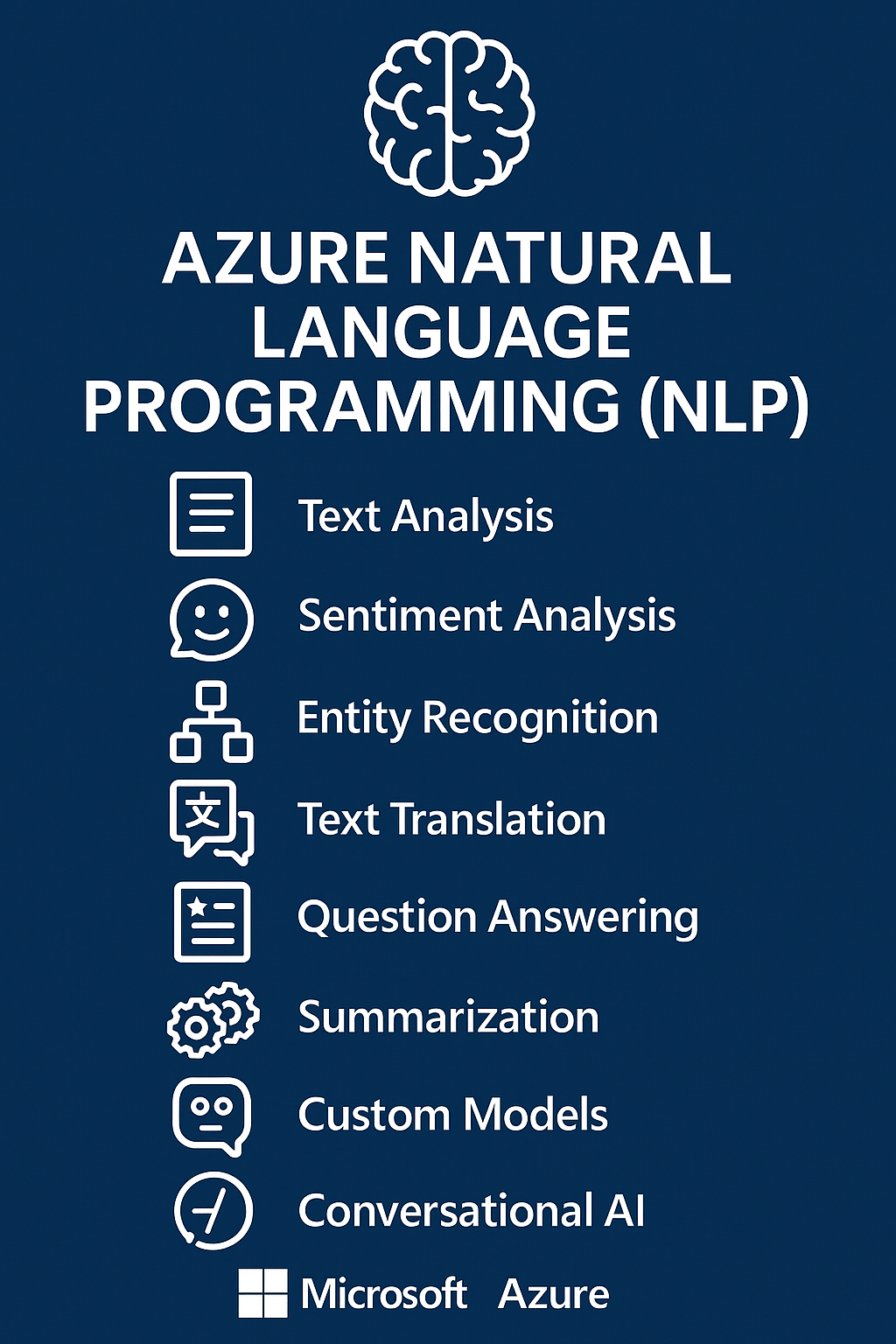
The learning content aligns to Microsoft’s “Develop natural language solutions in Azure” path. You’ll practice analyzing text, building question answering, training conversational Azure natural language programming training with language understanding (CLU) intents and entities, creating custom text classification and custom NER, and adding translation and speech (STT/TTS), with exposure to generative workflows through Azure AI Foundry where relevant. The emphasis is on shipping a working language solution rather than studying theory in the abstract.
Microsoft AI-3003 training is aimed at intermediate practitioners like AI engineers and developers who tend to be comfortable in the Azure portal, who can provision AI resources, and who can work in either Python or C#. You’re expected to use both Language Studio and code to build, train, and integrate models into applications.
In practice, the skills you demonstrate map directly to real product needs powered by Azure AI Language—tasks like sentiment analysis, entity extraction, summarization, language detection, custom classification/NER, and conversational understanding. Because the credential is scenario-based, it also complements broader certifications (e.g., AI-102) by proving you can execute an end-to-end Azure NLP August 2025 training build on the modern Microsoft Azure AI cloud platform today.
Microsoft offers role-based certifications in Artificial Intelligence and Machine Learning on Azure’s platform. Two prominent intermediate-level credentials are: Microsoft Certified: Azure AI Engineer Associate (Exam AI-102) and Microsoft Certified: Azure Data Scientist Associate (Exam DP-100). Both validate expertise in designing and implementing AI solutions on Azure, but each targets a different aspect of the AI/ML workflow. Earning these certifications not only proves one’s technical competency but also is a career booster, as certified AI professionals are in high demand and often earn higher salaries than their non-certified peers. In this deep dive, we focus on the training paths for each certification, compare their scopes (including a comparison to AI-102 specifically), and discuss how attaining them demonstrates skills and improves job prospects in 2025.
Microsoft Certified: Azure AI Engineer Associate (Exam AI-102)
Certification & Exam: The Azure AI Engineer Associate certification is earned by passing Exam AI-102: Designing and Implementing a Microsoft Azure AI Solution. This credential is intended for developers and AI engineers who build intelligent applications integrating Azure’s AI services. According to Microsoft’s description, it involves “design and implement an Azure AI solution using Azure AI services, Azure AI Search, and Azure OpenAI”. In practice, an Azure AI Engineer designs end-to-end AI systems leveraging services like Azure Cognitive Services (for vision, speech, and language AI), Azure Cognitive Search (knowledge mining), Azure Bot Service (intelligent agents), and Azure OpenAI Service for generative AI. The exam covers a broad range of AI solution areas, including planning an AI project and implementing solutions for generative AI, agent/bot applications, computer vision, natural language processing (NLP), and knowledge mining. Candidates are expected to be proficient in programming (especially Python or C#) and capable of using Azure SDKs and REST APIs to build secure AI solutions for images, videos, language understanding, and more. Familiarity with the Azure AI portfolio of services and applying Responsible AI principles is also required.
Training Path: To prepare for August 2025 and beyond Azure AI-102 training, it’s recommended to start with a foundation in AI concepts. Many begin with Azure AI Fundamentals (AI-900), which introduces core AI and machine learning concepts and the basic Azure AI services (covering topics like common AI workloads, ML types, and Azure tools for tasks like computer vision). While AI-900 is not a prerequisite, it helps build necessary background knowledge. Next, aspiring Azure AI Engineers should gain hands-on experience with Azure’s AI services. Microsoft offers free official learning paths and modules on Microsoft Learn for AI-102, which systematically cover all exam topics and include interactive labs. Key learning areas include building and deploying AI models using Azure Machine Learning, leveraging pre-built models via Cognitive Services (for vision, speech, language), and integrating these into applications using APIs/SDKs. Because the certification has a very practical focus, hands-on projects are crucial – for example, one might practice by creating a chatbot with Azure Bot Framework, implementing image recognition with the Computer Vision API, or developing a knowledge mining solution with Cognitive Search. Microsoft’s official AI-102 training course (AI-102T00) and documentation emphasize real-world skills like deploying machine learning models, integrating AI into applications, and monitoring and optimizing AI services.
Preparation Tips: Use a combination of study resources – Microsoft Learn modules, official study guides, and exam prep videos (Microsoft provides free AI-102 prep videos with tips and exam strategies). Take advantage of practice exams to gauge your readiness. It’s also beneficial to explore community resources or study groups, since discussing use-cases (like how to choose the right Azure AI service for a scenario) can deepen understanding. Ensure you are comfortable with calling Azure AI services through REST or SDK in code and have tried out different service functionalities (vision, NLP, etc.) in Azure. The exam may include case studies or practical questions, so familiarity with the Azure Portal and AI SDKs is valuable.
Proving Your Competency: Achieving the Azure AI Engineer Associate certification demonstrates you can build AI-powered solutions to meet business needs on Azure. It is an industry-recognized validation that you know how to incorporate AI into software projects using Azure’s state-of-the-art tools (including cutting-edge areas like generative AI). This proves to employers that you are capable of translating AI solution requirements into reality – from designing the system, to developing and deploying it, and then tuning and maintaining it. As Azure AI engineers often collaborate with architects, data scientists, and developers, the certification signals you have the breadth of knowledge to bridge these roles and deliver secure, scalable AI applications. In a competitive job market where businesses are racing to add AI capabilities, having AI-102 on your resume underscores your expertise and commitment to staying current with AI technology. Employers value this certification as proof that you not only understand AI theory but can apply Azure AI services effectively in production environments.
Microsoft Certified: Azure Data Scientist Associate (Exam DP-100)
Certification & Exam: The Azure Data Scientist Associate certification is earned by passing Exam DP-100: Designing and Implementing a Data Science Solution on Azure. This credential is aimed at professionals who specialize in machine learning, data science, and model development using Azure’s cloud services. In essence, it validates one’s ability to “manage data ingestion and preparation, model training and deployment, and machine learning solution monitoring with Python, Azure Machine Learning, and MLflow”. An Azure Data Scientist’s responsibilities span the entire ML lifecycle: setting up an Azure Machine Learning workspace and environment for data science, analyzing and cleaning data, performing feature engineering (handling data imbalances, feature selection/extraction), training and tuning machine learning models, and deploying models as scalable services or pipelines. The DP-100 exam tests skills in designing an appropriate ML approach for a given problem, running experiments to train and validate models, preparing models for production, deploying and operationalizing those models on Azure, and (newly added in the latest exam updates) optimizing and using large language models (LLMs) for AI applications. In other words, beyond “traditional” ML tasks, today’s Azure Data Scientist certification also expects knowledge of leveraging Azure AI services (like cognitive services or Azure OpenAI) and techniques for fine-tuning or optimizing AI models (e.g. working with Azure AI Foundry for enterprise AI operations).
Training Path: A strong background in data science and machine learning is crucial before tackling DP-100. If you are new to Azure or data science, starting with Azure Data Fundamentals (DP-900) and Azure AI Fundamentals (AI-900) can be helpful – DP-900 covers basic data concepts and Azure data services, while AI-900 covers AI/ML basics and Azure AI offerings. With fundamentals in place, the core of your preparation should be mastering the Azure Machine Learning service. Microsoft provides an official learning path for DP-100 on Microsoft Learn, which includes modules on creating Azure ML workspaces, managing data and compute resources, experiment tracking, model training with the Azure ML SDK, using MLflow for experiment tracking, and deploying models as endpoints. Hands-on practice in Azure ML Studio is highly recommended – for example, work through training a model (such as a scikit-learn or TensorFlow/PyTorch model) in a Jupyter notebook using Azure ML, then deploy it to an endpoint and set up a pipeline. The exam expects familiarity with the Azure ML SDK (Python), so get comfortable writing code to configure runs, datasets, and model outputs. Additionally, study how to use Azure ML’s AutoML, how to monitor models, and how to retrain or update models. Given the exam’s inclusion of optimizing language models, you should also explore Azure’s offerings for NLP and generative AI – e.g. using Azure OpenAI Service to fine-tune a model or using pre-trained models within Azure ML. Microsoft’s DP-100 study guide and training materials outline the key skill areas: designing an ML solution, exploring and preparing data, model training & evaluation, deploying and managing models. Make use of those resources and practice exams to identify any knowledge gaps. It’s also useful to review case studies of applied data science on Azure (for instance, examples of training models on Azure and deploying via MLOps). Community blogs and forums (like the Azure community on Reddit) can provide tips – e.g., successful test-takers often emphasize studying the Azure ML SDK v2 documentation and doing the official labs as the best preparation.
Preparation Tips: Ensure you have solid Python skills for data science and are familiar with common ML frameworks (scikit-learn, PyTorch, TensorFlow), since Azure ML can integrate with these. Practice end-to-end projects: from pulling in a dataset, experimenting locally or in Azure ML, to deploying the model behind an API. This helps build confidence in each stage that the exam will cover. Pay attention to topics like data drift detection, model monitoring, and retraining, as managing a model in production is a key competency. Use Azure’s free tier or credits to get real experience with the platform. The exam does not include hands-on lab tasks at the moment (it’s a proctored exam with questions), but scenario-based questions will expect you to apply knowledge, so hands-on familiarity is crucial. Like AI-102, leverage official tutorials and practice tests, and consider joining study groups or taking a structured course if you prefer guided learning. Microsoft Learn’s DP-100 learning path and the DP-100 prep video on Microsoft’s site are great starting points.
Proving Your Competency: Earning the Azure Data Scientist Associate certifies that you can build and operationalize machine learning solutions in Azure’s environment. It signals to employers that you have practical expertise in solving real-world data science problems using Azure tools – from preparing raw data for analysis to deploying a trained model as a service. This is a strong demonstration of competency in the field of AI/ML, because it covers both data science knowledge and cloud engineering skills. With this certification, you prove you understand how to use cloud-based ML pipelines and can manage the complexities of training models at scale (like using cloud compute, handling big data, tracking experiments, etc.). In 2025, as more companies incorporate AI and data-driven decision making, having DP-100 showcases you are prepared to lead those initiatives. It’s an assurance of your ability to execute machine learning projects end-to-end: for instance, an employer can trust that a certified Azure Data Scientist knows how to choose appropriate algorithms, optimize model performance, and deploy the model following MLOps best practices on Azure. Moreover, the inclusion of modern AI elements (like optimizing large language models) in the certification means you’re up-to-date with the latest AI trends and tools, which further proves your value and technical currency in this fast-evolving field.
Azure AI Engineer vs. Azure Data Scientist – Key Differences and Comparison to AI-102
Both AI-102 (Azure AI Engineer) and DP-100 (Azure Data Scientist) certifications are closely related to building AI solutions on Azure, but they focus on different professional roles and skill sets. Here’s a comparison to highlight how they differ:
- Focus of Role: An Azure AI Engineer (AI-102) specializes in integrating AI into applications – often using Azure’s ready-made AI services. This role is about building intelligent features (such as vision recognition, language understanding, chatbots, etc.) into software solutions without always needing to create custom ML models from scratch. In contrast, an Azure Data Scientist (DP-100) is focused on the machine learning modeling process itself – they spend more time on data preparation, experimenting with algorithms, training custom models, and deploying those models. Essentially, AI Engineers are consumers and integrators of AI services (and occasionally custom models), whereas Data Scientists are producers of new models and insights from data. Each certification reflects this: AI-102 covers services like Cognitive Services, Knowledge Mining, Bot Service, and how to apply AI capabilities via Azure’s APIs, whereas DP-100 covers using Azure ML to develop and manage ML models, data workflows, and advanced analytics.
- Skills and Tools Emphasized: For AI-102, knowledge of Azure Cognitive Services, Azure OpenAI, and deploying solutions via APIs/SDKs is key. You’re expected to know how to call pre-trained AI models (for vision, speech, language, etc.) and orchestrate them into an application. Basic understanding of machine learning is needed too, but heavy data science is not the primary focus – instead, you should know things like how to customize cognitive services (e.g., train a custom vision model or custom text classification using Azure’s services) and how to build an AI-driven app end-to-end (including security and monitoring of those services). Coding is often around integrating services (e.g., writing an app that calls Azure’s Face API or Language Understanding). On the other hand, DP-100 demands stronger data science and coding skills for model training. You’ll be using Python to work with data, selecting algorithms, using libraries like scikit-learn or PyTorch inside Azure ML, writing code to split data, train and evaluate models, etc. It also involves using Azure ML tools (CLI/SDK or Studio UI) for automating experiments and deployments, and knowledge of ML Ops frameworks like MLflow for tracking. In short, AI-102 is more service-oriented (what Azure AI services to use and how to use them), while DP-100 is more process-oriented (how to build a new machine learning solution on Azure from the ground up).
- Prerequisites & Difficulty: Neither exam requires another certification as a prerequisite; however, the ideal starting points differ. For AI-102, having software development experience and perhaps an Azure Developer or Azure Fundamentals background is useful since you’ll be integrating APIs into apps. For DP-100, having a background in data science or analytics (statistics, machine learning principles) is very important, as well as comfort with coding in Python for data tasks. Some learners find DP-100 to require more depth in math/ML theory and Azure ML specifics, whereas AI-102 requires breadth across many AI services but each at a slightly more introductory level. If one has completed AI-900 (AI Fundamentals), the decision on what to tackle next might depend on interest: AI-102 (AI Engineer) if you enjoy building applications with AI components, or DP-100 (Data Scientist) if you enjoy model building and data analysis. In fact, community discussion often revolves around which to do first – one suggestion is that if you’re aiming to eventually do both, consider starting with the one aligned to your current skillset (developers may find AI-102 more straightforward, while those with research or data backgrounds might start with DP-100). Importantly, there is some overlap: both exams expect you to understand fundamental AI concepts and some Azure services (for example, both mention Azure Cognitive Services and both now touch on working with language models/LLMs). This means skills learned for one can help with the other – but the application of those skills differs.
- Applications in Azure: Both certifications demonstrate capability to leverage Azure for AI solutions, but in practice the types of projects might differ. A certified Azure AI Engineer might work on projects like implementing a chatbot for customer service using Azure Bot Service and Language Understanding, or adding an image analysis feature to a mobile app using Azure’s Computer Vision API, or building a system that uses Azure OpenAI’s GPT models to generate content for an application. These are Azure AI application scenarios – taking AI services and applying them to solve business needs. A certified Azure Data Scientist, however, might be tackling projects like developing a predictive model for customer churn using Azure Machine Learning, or creating a recommendation engine by training a model on Azure Databricks/Azure ML and deploying it as a web service, or fine-tuning a large language model on custom company data to improve an internal knowledge base. These projects are more research and experiment heavy, involving custom model development and data pipelines, all within Azure’s ecosystem. In summary, AI-102 aligns with building AI-infused applications in Azure, whereas DP-100 aligns with doing data science and ML projects on Azure. Both contribute to the broader AI capability of an organization and often Azure AI Engineers and Azure Data Scientists work closely together – one building the model, the other integrating it into an application.
Which one to choose? If you are evaluating which certification (and career path) suits you, consider your interest and career goals. AI Engineer (AI-102) is great for those who want to be solutions developers delivering intelligent apps – it’s somewhat akin to a software engineer with specialization in AI services. Data Scientist (DP-100) is ideal for those who want to delve into data, algorithms, and model tuning – more like a research-oriented or analytics role. Some professionals eventually obtain both certifications to be well-rounded, but it’s often wise to start with the one that matches your current role or the role you aspire to. Both certifications are highly respected and signal that you can contribute to AI projects, just in different capacities. Notably, Microsoft’s addition of generative AI content in both exams shows that whichever path you choose, you’ll be learning cutting-edge AI skills (like working with GPT models and responsible AI techniques), keeping you relevant in the AI job market of 2025 and beyond.
Career Impact, Job Roles, and Salaries in 2025
Achieving either of these Azure AI certifications can significantly boost your career opportunities. They serve as a formal recognition of your expertise, which can help you stand out in job applications and promotions. In 2025, organizations across industries (tech, finance, healthcare, etc.) are investing heavily in AI-driven solutions, and they seek professionals who can demonstrate the skills to build and deploy these solutions. Microsoft certifications carry global recognition for their rigor and relevance. By earning the Azure AI Engineer or Data Scientist cert, you signal that you have passed a strict assessment of applicable skills – which many hiring managers interpret as a reduced risk in hiring and an assurance of a certain level of competence.
Job Roles: With the Azure AI Engineer Associate (AI-102) certification, typical job titles you can pursue include Azure AI Engineer, Cognitive Services Developer, AI Solutions Architect (Associate level), Machine Learning Engineer (with Azure focus), or Chatbot Developer. Essentially, roles that involve creating AI-enhanced applications or deploying AI services will align well. These roles often involve working in teams with data scientists and software engineers to integrate AI models into products. With the Azure Data Scientist Associate (DP-100) certification, you can aim for roles such as Data Scientist, Machine Learning Engineer, AI ML Specialist, or Analytics Specialist where the core task is building and evaluating models and turning data into insights on Azure. In some cases, Azure Data Scientists also fill roles like AI Researcher or ML Ops Engineer, as the certification covers aspects of model operationalization. Many job postings for data scientists now list cloud ML experience as a plus – having DP-100 proves you have that specific Azure ML experience. It’s also worth noting that cloud AI expertise is multi-faceted: some roles advertised as “AI Engineer” might expect both sets of skills (integrating AI services and training custom models), especially in smaller companies, so either cert (or both) can be useful.
Salary and Market Value (2025): AI and cloud skills command premium salaries, and these certifications can help you tap into those higher ranges by demonstrating validated skills. According to industry reports, Azure-certified AI professionals earn substantially more on average. For instance, Azure AI Engineer certification holders often earn in the six-figure range – typically around $130,000 to $180,000 per year in the U.S., with experienced Azure AI engineers in top markets making upwards of $200,000 annually. In fact, one 2024 analysis listed the Azure AI Engineer Associate among the top highest-paying Azure certs, noting certified individuals commonly see salaries between $130K and $180K and that major tech companies (like Microsoft, Google, IBM, etc.) actively recruit for this skillset. For Azure Data Scientists, salary ranges are similarly high. Data from 2025 shows an Azure Data Scientist role in the U.S. averaging roughly $125,000 per year, with typical ranges from about $120K up to $190K+ depending on experience. Another source indicates Azure AI specialists (which can include both AI Engineers and Data Scientists) can earn between $146,000 and $224,000 at the high end in the U.S.. These numbers reflect the strong demand and the relatively scarce supply of professionals who deeply understand cloud-based AI – companies are willing to pay a premium for talent that can drive their AI initiatives.
Beyond raw numbers, the certifications can have an indirect career benefit on earnings. Global Knowledge and other surveys have found that certified IT professionals make around 8-10% more than their non-certified counterparts on average. In the AI domain, this gap can be even larger because the certification may qualify you for higher-responsibility roles. For example, an IT professional might move from a general software engineer role (lower salary) into an AI specialist role (higher salary) after certification. Moreover, having these credentials can accelerate your career progression: you might attain senior roles faster or be given leadership on new AI projects, leading to raises or bonuses. The credibility the cert provides helps in salary negotiations as well – it’s concrete evidence of your skills when asking for a higher pay grade.
Demonstrating Worth: Ultimately, earning the Azure AI Engineer or Data Scientist certification proves your worth in a very tangible way. It shows you have put in the effort to master complex topics and that you can deliver value using Azure’s AI offerings. Employers and clients see the certification as validation that you can be trusted to work on critical AI projects – whether it’s implementing a new AI-powered feature or designing a machine learning model that could give the company a competitive edge. In the fast-moving field of AI, where new tools and techniques emerge constantly, a current Microsoft certification also demonstrates your commitment to staying up-to-date and your ability to learn and adapt (since Microsoft updates these exams frequently, as evidenced by the inclusion of generative AI topics by 2025). This competency demonstration can be the difference in landing a job or promotion: for instance, if a company is migrating its AI workflows to Azure, a certified Azure AI professional will clearly stand out as a valuable asset.
In summary, both the Azure AI Engineer Associate (AI-102) and Azure Data Scientist Associate (DP-100) certifications offer tremendous career value. They each pave the way to exciting, well-paid roles working on cutting-edge AI solutions in Azure. By following the training paths and achieving certification, you not only gain in-depth knowledge but also a stamp of approval from Microsoft that can boost your professional credibility. In 2025’s job market, where AI skills are more prized than ever, these certifications can help you unlock opportunities and command a higher salary, all while equipping you with the know-how to build intelligent solutions on one of the world’s leading cloud platforms.
Have a Question ?
Fill out this short form, one of our Experts will contact you soon.
Talk to an Expert Today
Call Now