

9:00 AM – 4:00 PM CST
Reserve Your Seat
- Virtual instructor Led Training
- Complete Hands-on Labs
- Softcopy of Courseware
- Learning Labs
- Virtual instructor Led Training
- Complete Hands-on Labs
- Softcopy of Courseware
- Learning Labs
- You can use your Purchase Card and checkout
- The GSA Contract Number: 47QTCA20D000D
- Call 800-453-5961 for details
- Customize your class
- Delivery Onsite or Online for your organization
- Choice of Dates when and where you want
- Guidance in choosing and customizing your class
Question About this Course?
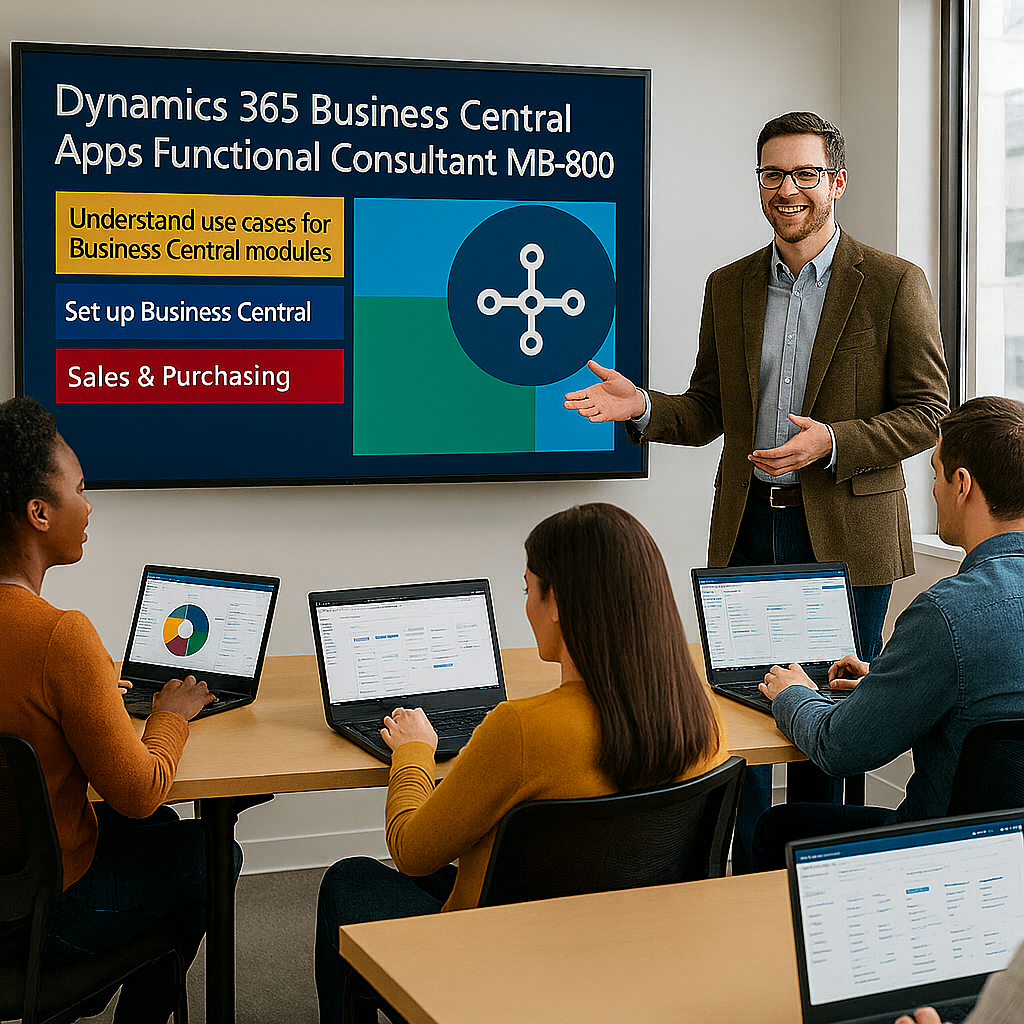
MB-800: Manage Business Solutions with Microsoft Dynamics 365 Business Central
MB-800T00: Manage business solutions with Microsoft Dynamics 365 Business Central is an instructor-led course for functional consultants who implement and configure Business Central for small and medium businesses. Students learn how to configure the core application, create companies, migrate data, configure financials, set up sales and purchasing, manage inventory, process transactions, and support Business Central operations.
Certification: Microsoft Certified: Dynamics 365 Business Central Functional Consultant Associate
Exam: MB-800: Microsoft Dynamics 365 Business Central Functional Consultant
Choose Dynamics Edge for MB-800 training
Dynamics Edge delivers MB-800 training with practical configuration examples, hands-on labs, certification review, and implementation-focused discussion. The course helps students understand how Business Central supports finance, sales, purchasing, inventory, approvals, reporting, and daily business operations.
- Learn how Business Central supports financial management, sales, purchasing, inventory, fixed assets, and operations.
- Practice configuration tasks used in real Business Central implementation projects.
- Prepare for the MB-800 certification exam with structured course review.
- Understand how Business Central connects with Microsoft 365, Power Platform, and Dynamics 365.
- Request private team delivery for ERP implementation, upgrade readiness, role-based onboarding, or finance team training.
What will you learn in MB-800 training?
Students learn how to configure and operate Microsoft Dynamics 365 Business Central. The course emphasizes company setup, financial configuration, posting groups, journals, bank accounts, receivables, payables, sales, purchasing, inventory, workflows, and operational processing.
- Create and configure companies, configuration packages, users, security, number series, workflows, and dimensions.
- Configure financial management, chart of accounts, posting groups, journals, bank accounts, AP, AR, currencies, and fixed assets.
- Configure inventory, items, locations, sales setup, purchasing setup, pricing, discounts, customers, and vendors.
- Process purchases, sales, invoices, credit memos, payments, receipts, bank reconciliation, and inventory transactions.
- Use Business Central productivity features including personalization, page inspection, Excel, Outlook, Teams, Power Platform, and Copilot-enabled features.
Dynamics 365 Business Central MB-800 Course Outline
Learning Path 1: Set up Business Central
Module 1: Create and configure a company
Students learn how to create a new Business Central company and configure the company for implementation. They review Assisted Setup, configuration packages, company setup, opening balances, and data migration planning.
Topics include:
- Create a new company in Business Central.
- Configure a company by using Assisted Setup.
- Create configuration worksheets and configuration packages.
- Import master data and opening balances.
- Validate company setup before operations begin.
Module 2: Manage security
Students learn how to configure Business Central security for users, profiles, roles, and permissions. They review how security supports functional consultant responsibilities during implementation and user onboarding.
Topics include:
- Create and configure users.
- Assign user profiles and role centers.
- Configure permission sets.
- Use security groups and security filters.
- Review security auditing and access control.
Module 3: Set up core functionality
Students configure the core application settings used throughout Business Central. They review number series, reports, job queues, notifications, feature management, and system setup options.
Topics include:
- Configure number series.
- Set up reports and report layouts.
- Configure job queues.
- Manage feature management options.
- Configure core system behavior.
Module 4: Set up dimensions
Students learn how dimensions support reporting, segmentation, and analysis across Business Central. They configure dimension values, global dimensions, shortcut dimensions, default dimensions, and dimension combinations.
Topics include:
- Create dimensions and dimension values.
- Configure global and shortcut dimensions.
- Assign default dimensions to master data.
- Configure dimension combinations.
- Resolve dimension posting conflicts.
Module 5: Manage approvals by using workflows
Students learn how to configure workflows and approvals in Business Central. They review purchase approval workflows, workflow users, approval users, notifications, and workflow setup.
Topics include:
- Configure native workflows.
- Set up approval users.
- Configure workflow user groups.
- Set up workflow notifications.
- Configure and use purchase approval workflows.
Module 6: Describe Business Central integrations with other products
Students review how Business Central connects with Microsoft 365, Power Platform, Dataverse, Teams, Outlook, Excel, OneDrive, and other Microsoft applications. They learn when integrations support productivity, automation, and reporting.
Topics include:
- Describe Power Platform integration use cases.
- Describe Outlook and Teams integration.
- Review Excel and OneDrive integration.
- Describe Dataverse integration concepts.
- Review Copilot and AI-assisted Business Central capabilities.
Learning Path 2: Configure financials
Module 7: Set up financial management
Students learn how to configure financial management foundations in Business Central. They review general ledger setup, accounting periods, payment terms, payment methods, currencies, exchange rates, and deferrals.
Topics include:
- Configure general ledger setup.
- Configure accounting periods.
- Set up payment terms and payment methods.
- Configure currencies and exchange rates.
- Set up deferrals.
Module 8: Manage the chart of accounts
Students learn how to configure and maintain the chart of accounts. They review account categories, subcategories, financial reporting, G/L accounts, account schedules, and general ledger structure.
Topics include:
- Create and maintain G/L accounts.
- Configure account categories and subcategories.
- Prepare financial reporting structures.
- Review account schedules and reporting options.
- Configure general ledger allocations.
Module 9: Set up posting groups
Students learn how posting groups connect master data and transactions to the general ledger. They configure general posting groups, specific posting groups, inventory posting setup, and posting setup relationships.
Topics include:
- Configure general business and product posting groups.
- Configure customer and vendor posting groups.
- Configure inventory posting groups.
- Configure general posting setup.
- Allow and manage multiple posting groups.
Module 10: Set up journals and bank accounts
Students configure general journals, journal templates, journal batches, recurring journals, bank accounts, and bank-related posting setup. They learn how journals support daily finance operations.
Topics include:
- Configure journal templates.
- Create journal batches.
- Configure recurring journals.
- Create and configure bank accounts.
- Prepare journals for daily posting.
Module 11: Set up accounts payable
Students configure vendor-related financial setup. They review vendor accounts, vendor posting groups, purchase setup, payment terms, vendor bank accounts, payment journals, and vendor ledger entries.
Topics include:
- Create and maintain vendor accounts.
- Configure Purchases & Payables Setup.
- Configure vendor posting groups.
- Set up payment journals.
- Review vendor ledger entries and detailed ledger entries.
Module 12: Set up accounts receivable
Students configure customer-related financial setup. They review customer accounts, customer posting groups, sales setup, payment methods, cash receipt journals, payment registration, and customer ledger entries.
Topics include:
- Create and maintain customer accounts.
- Configure Sales & Receivables Setup.
- Configure customer posting groups.
- Set up cash receipt journals.
- Review customer ledger entries and detailed ledger entries.
Module 13: Configure fixed assets
Students learn how to configure fixed assets for acquisition, depreciation, and disposal. They review fixed asset classes, subclasses, depreciation books, main assets, components, and depreciation methods.
Topics include:
- Configure fixed asset setup.
- Create fixed asset classes and subclasses.
- Configure depreciation books.
- Create fixed assets and components.
- Compare depreciation methods.
Learning Path 3: Configure sales and purchasing
Module 14: Set up inventory
Students learn how Business Central inventory setup supports sales, purchasing, costing, and operations. They configure items, item categories, attributes, units of measure, locations, variants, costing methods, and stockkeeping units.
Topics include:
- Configure inventory setup.
- Create items and item categories.
- Configure item attributes and units of measure.
- Create locations and stockkeeping units.
- Review item ledger entries and value entries.
Module 15: Configure master data for sales and purchasing
Students configure customer and vendor master data used in sales and purchasing processes. They review shipping agents, order addresses, lead times, locations, and related master data relationships.
Topics include:
- Configure customer master data.
- Configure vendor master data.
- Configure shipping agents and shipping addresses.
- Configure vendor order addresses and lead times.
- Review master data dependencies for transactions.
Module 16: Configure pricing and discounts
Students learn how to manage sales and purchasing prices and discounts. They configure customer sales prices, vendor purchase prices, sales discounts, purchase discounts, invoice discounts, and pricing policies.
Topics include:
- Configure customer sales prices.
- Configure vendor purchase prices.
- Configure sales line and invoice discounts.
- Configure purchase line and invoice discounts.
- Review pricing and discount behavior on documents.
Learning Path 4: Perform Business Central operations
Module 17: Perform basic tasks in Business Central
Students learn how to use common Business Central productivity features. They review personalization, page customization, filtering, page inspection, data analysis mode, Edit in Excel, search, document navigation, and common user tasks.
Topics include:
- Personalize and customize pages.
- Apply and save filters.
- Use page inspection.
- Use Edit in Excel.
- Use data analysis mode.
Module 18: Process purchases
Students process purchasing transactions from quote or order through receipt and invoice. They review purchase orders, receipts, over-receipts, returns, blanket purchase orders, recurring purchase lines, and purchase deferrals.
Topics include:
- Create and process purchase orders.
- Receive items for purchase orders.
- Process over-receipts and undo receipts.
- Create invoices from purchase orders.
- Process purchase returns and blanket purchase orders.
Module 19: Process sales
Students process sales transactions from quote through order, shipment, and invoice. They review sales quotes, sales orders, item availability, shipments, returns, recurring sales lines, blanket sales orders, and sales deferrals.
Topics include:
- Create and convert sales quotes.
- Process sales orders and sales invoices.
- Analyze item availability.
- Ship items and reverse shipments.
- Process sales returns and blanket sales orders.
Module 20: Process financial documents
Students process financial documents used in purchase and sales operations. They review purchase invoices, purchase credit memos, sales invoices, sales credit memos, combined shipments, combined receipts, posted document correction, and prepayment invoices.
Topics include:
- Process purchase invoices and credit memos.
- Process sales invoices and credit memos.
- Combine sales shipments into invoices.
- Combine purchase receipts into invoices.
- Correct posted invoices and process prepayments.
Module 21: Process payments and journals
Students process payment and journal activities used by finance teams. They review payment journals, cash receipt journals, payment registration, bank deposits, recurring journals, entry application, reversals, bank reconciliation, currency adjustments, and dimension correction.
Topics include:
- Process payments by using payment journals.
- Process receipts by using cash receipt journals.
- Apply and undo ledger entries.
- Perform bank account reconciliation.
- Reverse journals and correct dimensions.
Module 22: Describe common Business Central module features
Students review additional Business Central capabilities that support operations beyond core finance, sales, purchasing, and inventory. They explore warehouse, jobs, resources, manufacturing, service management, and assembly management.
Topics include:
- Describe warehouse module features.
- Describe job module features.
- Describe resource module features.
- Describe manufacturing module features.
- Describe service and assembly management features.
Hands-on labs
The MB-800 labs support hands-on practice for Microsoft Dynamics 365 Business Central functional consultants.
- Lab 1: Create and configure a new company.
- Lab 2: Migrate master data to a new company.
- Lab 3: Set up dimensions.
- Lab 4: Set up and use a purchase approval workflow.
- Lab 5: Configure chart of accounts and posting groups.
- Lab 6: Set up general journals.
- Lab 7: Set up cash management.
- Lab 8: Process cash management.
- Lab 9: Set up accounts payable.
- Lab 10: Set up accounts receivable.
- Lab 11: Set up inventory.
- Lab 12: Configure purchasing.
- Lab 13: Configure sales.
- Lab 14: Process purchases.
- Lab 15: Process sales.
- Lab 16: Configure users, profiles, permissions, and security groups.
- Lab 17: Configure number series, job queues, and core application settings.
- Lab 18: Configure fixed assets, depreciation books, classes, and asset records.
- Lab 19: Process payments, receipts, bank reconciliation, and recurring journals.
- Lab 20: Process inventory transactions, transfers, counting, reclassification, and cost adjustments.
Certification alignment
This course supports preparation for Exam MB-800: Microsoft Dynamics 365 Business Central Functional Consultant. The exam validates the ability to configure Business Central, set up financials, configure sales and purchasing, and perform Business Central operations.
MB-800 skills measured
- Set up Business Central.
- Configure financials.
- Configure sales and purchasing.
- Perform Business Central operations.
Course review
Students should leave the course able to configure and operate the major areas of Business Central. The course review should reinforce company setup, migration, security, dimensions, workflows, financial setup, chart of accounts, posting groups, journals, bank accounts, accounts payable, accounts receivable, fixed assets, inventory, purchasing, sales, and operational processing.
Certification exam review
Exam review should focus on configuration dependencies, posting behavior, business process flow, and operational troubleshooting. Priority review areas should include company setup, configuration packages, dimensions, approval workflows, G/L setup, posting groups, journals, cash management, AP, AR, fixed assets, inventory, purchasing, sales, payment processing, bank reconciliation, and Business Central productivity features.
Question About this Course?
Need help picking the right course?
Call Now